Hospital Equipment Management and Health Education: How to Choose Digital Tools
As the digital transformation of the medical system speeds up, more and more hospitals are re-examining the "inconspicuous but key" links in internal operations. Medical equipment management and health education are typical representatives: one bears on a hospital's operating efficiency and cost control, the other carries the mission of raising the nation's health literacy. But from actual research, the long-standing structural problems in these two fields are far from effectively solved.
In this context, the tool's role is redefined: no longer just "assisting execution" but a fulcrum for opening up processes, improving experience, and raising quality. Starting from front-line practice, this article offers some workable references combined with exploration of CaoLiao QR Code's application in hospitals.
1. Medical Equipment Management: From Table Records to Refined Digital Management
1.1 High Failure Rates, Startling Idle Rates: Management Methods Urgently Need Updating
In quite a few hospitals, the procurement process for medical equipment is already quite mature, but problems in the use and maintenance stage have long been overlooked. Frequent failures, high maintenance cost, and low equipment utilization reflect not the equipment's own performance but missing management mechanisms.
And the most basic link of equipment management, "recording", still stays at inefficient means such as paper ledgers, Excel sheets, and offline signature passing in many hospitals. When a fault occurs, delayed information, unclear responsibility, and hard tracing have become consensus.
1.2 QR Code Empowerment: Build an "Electronic File" for Equipment and Link Up Daily Management
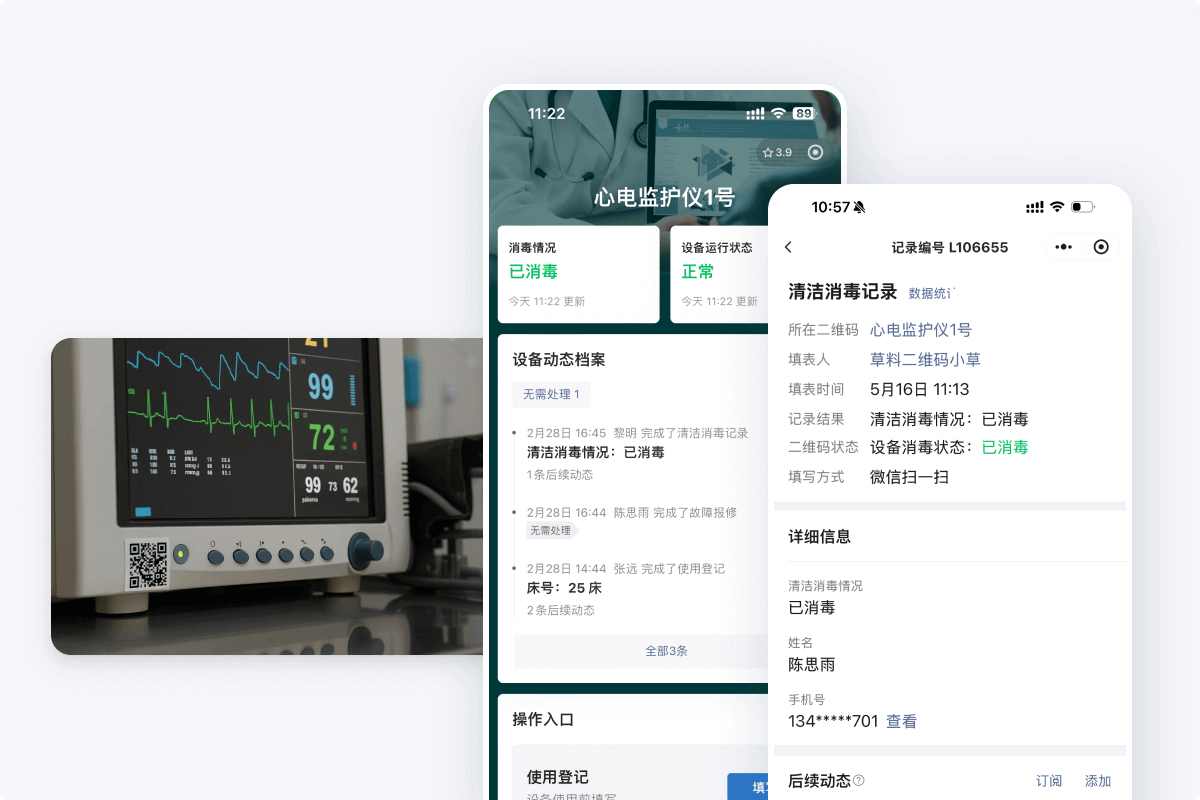
A realistic and workable way is to build a unique "QR code identity" for each piece of equipment. With a QR code tool like CaoLiao QR Code that needs no local system deployment and can be configured online, a hospital can quickly generate an electronic file QR code for each piece of equipment and stick it on the equipment body; staff scan to fill in forms for use registration, disinfection records, repair requests, and more, and the workbench syncs the data automatically, easing managers' review, statistics, and analysis.
Compared with traditional tables, the QR code has the following advantages:
- Unified entry: no dedicated app needed, and on-site staff can fill in by scanning with a phone;
- Structured information: all records are archived automatically under each piece of equipment, avoiding scatter;
- Rich displayed information: besides electronic forms, the QR code can add equipment status, equipment photos, operating guidance files, and more;
- Effective repair closed loop: if there's an abnormality, scan to report, repair staff are reminded by message in real time, and follow up and handle it promptly according to the fault record, recording the whole repair process.
These features lower the implementation threshold of full-lifecycle equipment management and also provide basic data support for later equipment status analysis, budget assessment, predictive maintenance, and more.
1.3 Not Replacing Systems but Filling Gaps
The QR code solution is not meant to replace hospitals' original systems (such as HIS and CMMS) but targets small and mid-sized equipment, portable equipment, peripheral consumables, and department-level supplementary inspection that haven't been systematically managed, filling the management gap of "usable but not covered". CaoLiao QR Code's strengths are:
- Free to use
- No dependence on local deployment or interface integration;
- Medical staff can create content independently with a low barrier;
- Low cost and quick trial and error, suited to fast pilots.
As equipment management increasingly demands refinement and full-process traceability, such tools offer a lightweight, pragmatic entry point for digitalization.
2. Health Education: From "Posters on the Wall" to "Scan to Ask Clearly"
2.1 Education Is Not About Whether It Was Done but "Whether It Works"
Health education has long been a representative of "heavy on execution, light on evaluation". How many display boards a hospital made, how many leaflets it handed out, how many lectures it held: behind these quantity indicators, what is the real spreading effect? Did patients understand? Did behavior change? It's hard to quantify.
A more common problem is that education content is mostly generic and non-personalized, with a single display channel and no follow-up tracking after the talk ends, leading to low knowledge conversion and weak patient engagement.
2.2 The QR Code as a Connecting Entry: Make Education Content More "Alive"
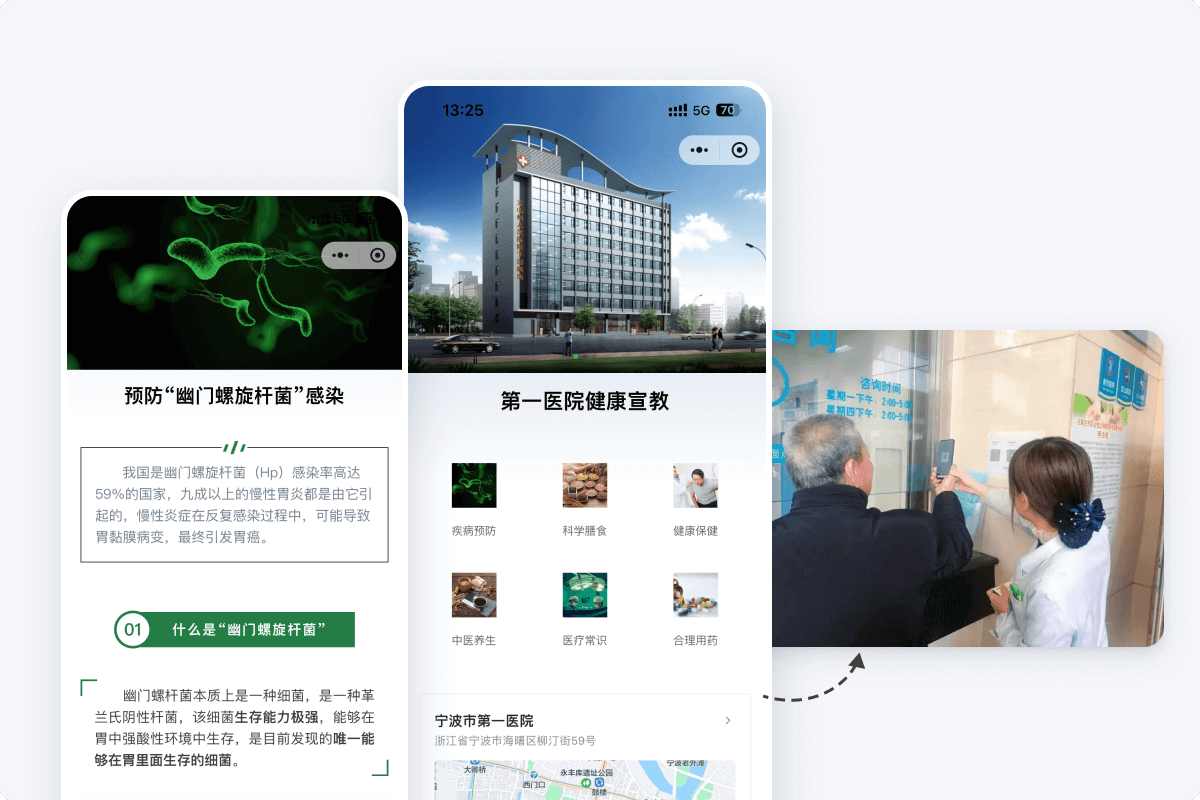
Compared with traditional static display, QR codes offer the possibility of a "lightweight interactive entry". After education content is made into an online page, a generated QR code is posted in hospital corridors, waiting areas, and wards, and patients can scan to read it. This is already widely adopted by many hospitals, but further optimization points are:
- Customizable, updatable content: CaoLiao QR Code supports generating "dynamic QR codes", where the code stays the same and content keeps updating, suited to scenarios like disease knowledge and medication guides that need frequent content changes;
- Categorized display: with the "directory code" feature, multiple content items can be gathered under one QR code, suited to scenarios needing several notes shown side by side, such as checkup instructions, post-surgery precautions, and chronic disease education;
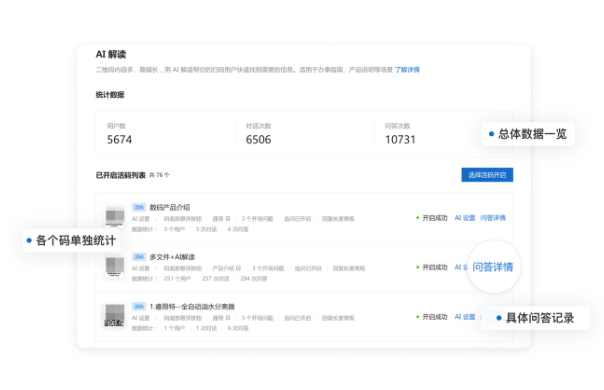
- Embedded AI interpretation: after scanning, patients can not only see content but also ask questions directly, and the system answers questions using the content on the page, helping patients understand complex terms and raising knowledge conversion.
Through these means, the QR code is no longer a static jump from "Scan" but takes on the role of an intelligent entry that guides, explains, and interacts.
2.3 From "What Was Sent" to "What Was Learned"
The research mentioned that the biggest problem in health education assessment is that it's hard to know whether patients truly understood and remembered the content. With the AI interpretation feature, the common questions patients ask after scanning can be summarized in the workbench, helping medical staff judge whether content is well designed, where patients' main confusions concentrate, and whether wording needs improvement.
This is closer to the real situation than an "awareness rate" and also gives data support for later content adjustment.
3. Criteria for Choosing Tools: Low Barrier, High Compatibility, Able to Close the Loop
From medical equipment management to health education, hospitals' common demands on tool choice are becoming clear:
- Low deployment barrier: no need to connect to in-hospital systems, no need for professional IT support;
- Flexible content arrangement: medical staff can configure and modify it themselves, adapting to multiple scenarios;
- Manageable data: filled-in records can be exported, analyzed, and tracked;
- Closed-loop process: not only "can fill in" but also supports later handling, feedback, and data retention.
Though lightweight, the QR code solution performs steadily on these dimensions, especially suited as a medium-to-short-term pilot and an interim solution to fill system gaps. For a hospital, before fully launching a big system, or in corners the big system can't cover, making good use of QR codes is a pragmatic path.
Conclusion: Digital Practice from "Usable" to "Easy to Use"
Research shows that, whether in equipment management or health education, China's hospitals currently face great pressure to move from extensive management to refined operations. In this transformation, digital tools matter not just for replacing manual work but, more critically, for providing an executable, traceable, and improvable mechanism.
CaoLiao QR Code is not a high-barrier, all-purpose complex system; it's more like a portable tool: before a hospital achieves full digitalization, it builds a standard, unified, clear entry for some link, lets data start accumulating, lets processes start to standardize, and lets small problems no longer be ignored.
This may be the most needed and most realistic kind of professionalism at the current stage. We can't expect a tool to solve all problems, but at least we can use it to push change to happen.