A Compliance Guide to the Cosmetics Electronic Label Pilot
The cosmetics electronic label pilot takes effect on February 1, 2026, for a period of 3 years. According to the Requirements for the Cosmetics Electronic Label Pilot (Annex 1) issued by the National Medical Products Administration (NMPA) and related technical specifications, a cosmetics company that wants to implement electronic labels needs to prepare across six steps: pilot eligibility, system building, information preparation, physical packaging, QR code printing, and filing submission.
CaoLiao QR Code compiled this guide from the documents below, all of which can be read in full on this site, to help everyone save time on organizing labels.
- Notice of the NMPA on Carrying Out the Cosmetics Electronic Label Pilot (Guo Yao Jian Zhuang [2025] No. 16)
- Requirements for the Cosmetics Electronic Label Pilot (Annex 1)
- Cosmetics Electronic Label Dataset (Annex 2)
- Technical Specification for Cosmetics Electronic Label QR Codes (Annex 3)
- Guangdong Province's Announcement on Carrying Out the Cosmetics Electronic Label Pilot (2025 No. 108)
1. Are You Within the Pilot Scope?
Before getting started, a company first needs to confirm that it meets the pilot's eligibility conditions. Pilot eligibility has two layers: unified national requirements, and application conditions each pilot jurisdiction sets itself.
1. Unified National Requirements
According to the notice, the pilot runs for 3 years and mainly targets the following parties:
- Eligible entity: must be a registrant or filer of cosmetics (including toothpaste), or a domestic responsible person authorized by a registrant or filer
- Region: the company must be registered in one of these 6 jurisdictions: Beijing, Shanghai, Zhejiang, Shandong, Guangdong, and Chongqing, and duty-free cosmetics on Hainan's offshore islands may follow it by reference
- Timing: formally in effect from February 1, 2026
- Management capability: the company must have a sound quality management system, dedicated management staff, and corresponding technical capability
2. Local Application Conditions (Guangdong as an Example)
Each pilot jurisdiction sets its own application thresholds and windows on top of the national requirements, so they are not uniform nationwide. Taking Guangdong Province's 2025 Announcement No. 108 as an example, companies applying for the pilot must additionally meet:
- Registration location: must be in Guangdong Province
- Scale requirement: annual sales of 50 million yuan or more, or annual industrial output value of 20 million yuan or more
- Credit requirement: no finding of "serious defects in the production quality management system" in the past 3 years; no record of deliberate illegal additives in the past 1 year; quality management system self-inspection reports and annual filing reports submitted on time
- Application window: June and December each year are pilot application periods, and materials are not accepted outside them
The sales, output value, and credit thresholds above are Guangdong's application conditions and do not apply to other jurisdictions. For the specific conditions in Beijing, Shanghai, Zhejiang, Shandong, Chongqing, and Hainan, follow the announcements issued by the local drug regulatory authority.
Companies should submit applications within the set time to the city-level market regulation authority where they are registered. For more national and local pilot notices, see the Cosmetics Electronic Label Knowledge Base.
2. Building the System: Build It Yourself or Commission a Third Party?
Companies can build the system themselves or commission a third-party technical service provider. The choice mainly depends on two things: whether you have ongoing development and operations ability, and whether you need deep integration with existing systems.
| Situation | Suggested Direction |
|---|---|
| No development team, or not sure you can take on 3+ years of system operations and scan availability assurance | Use a third-party system (such as the CaoLiao QR Code platform) to lower development and long-term operations costs |
| Already have ERP, traceability, and other systems and need deep integration with production batches and code-assignment lines | Evaluate building it yourself, or an API integration plan for a third-party system |
| Few product categories, mainly one code per product, wanting to finish the pilot application quickly | A third-party system goes live faster |
| Clear requirements for data localization or system autonomy | Evaluate the feasibility of building it yourself according to internal compliance requirements |
Either way, the cosmetics registrant or filer always bears primary responsibility for the legality, accuracy, and completeness of the electronic label. If a third-party system is used, the pilot company should sign an agreement with the third-party technical institution that sets out each side's rights, obligations, and responsibilities, and what the third party will proactively accept in extended inspections by the drug regulatory authority.
CaoLiao QR Code offers a cosmetics electronic label solution, available on the Flagship Edition (2,680 yuan/year) and above, which can quickly build electronic labels that meet the specification, supports signing a service agreement, and cooperates with regulatory extended inspections. Shihuanuo, among the first batch of pilot companies in Guangdong Province, used this solution and passed official review in 1 working day.
Basic System Requirements
According to Articles 5 and 6 of the Requirements for the Cosmetics Electronic Label Pilot (Annex 1):
- The system should cover the main functions of electronic label entry, management QR code generation, scanning to get the electronic label, querying the electronic label's history, and querying the electronic label's structured information
- The system should comply with the Cybersecurity Law, Data Security Law, Personal Information Protection Law, and related requirements; have tamper-proof capability and a sound backup and recovery mechanism, ensuring data accuracy, integrity, continuity, timeliness, availability, and traceability
- Continuity and stability of the scanning function must be guaranteed
- After a product using an electronic label is no longer produced or imported, the electronic label of the last batch of produced or imported product must display normally for 1 year after its period of use expires
- For products with a period of use under 1 year, the electronic label must display normally for no less than 2 years
3. Organizing the Electronic Label Information
The electronic label is part of the cosmetics label, and what appears after scanning must be true, accurate, and consistent with the registration or filing.
You can organize the materials as follows and enter them on the CaoLiao QR Code platform, using the CaoLiao QR Code compliance template to make the electronic label quickly.
1. Core Information That Must Be Shown
The following information must match exactly what was registered or filed with the NMPA:
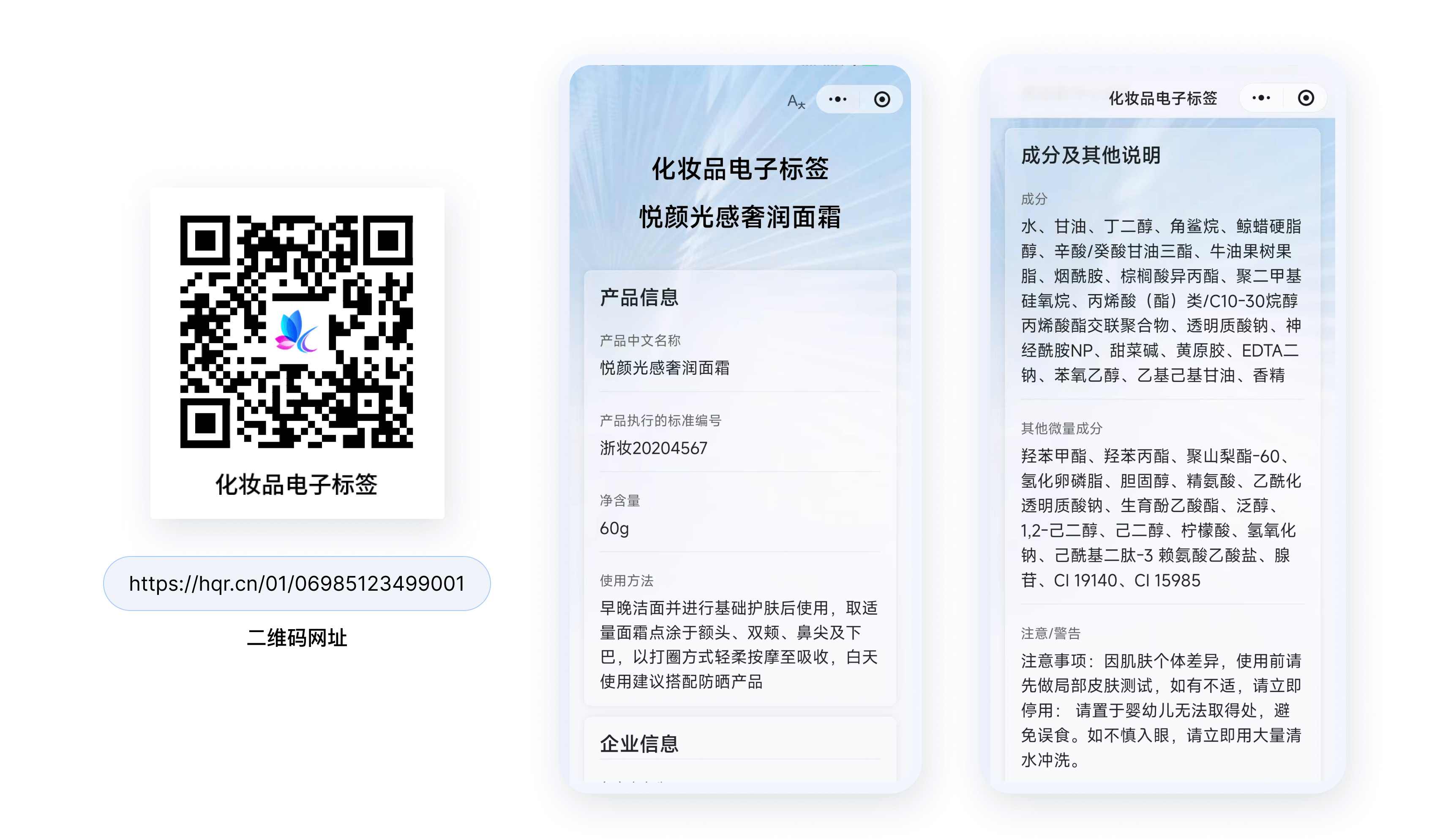
- Basic product information: Chinese product name, product execution standard number, special cosmetics registration certificate number (required for special cosmetics)
- Entity information (by product type)
- Ordinary cosmetics: filer's name and residential address
- Special cosmetics: registrant's name and residential address
- If the registrant/filer is an overseas company, the domestic responsible person's name and address must also be shown; production information includes the manufacturer's name and address and the production license number (for domestic cosmetics)
- Ingredient information
- Full ingredient listing (ingredients above 0.1% (w/w))
- Full ingredient listing (other trace ingredients, content not exceeding 0.1%)
- Net content: such as "50ml"
- Batch/date information: one set of production batch number and expiry date, or production date and shelf life, is required
- Other: safety warning statements (when required by laws, regulations, or mandatory standards), the children's cosmetics mark (if applicable)
2. Handling Production Date and Batch Number
According to Article 6.2 of the Technical Specification for Cosmetics Electronic Label QR Codes (Annex 3): When the URL data structure encoding information goes only down to the product identification unit, the company should state "See sales packaging" in the electronic label's production date, production batch number, expiry date, net content, and similar fields.
| Option | Approach | When It Fits |
|---|---|---|
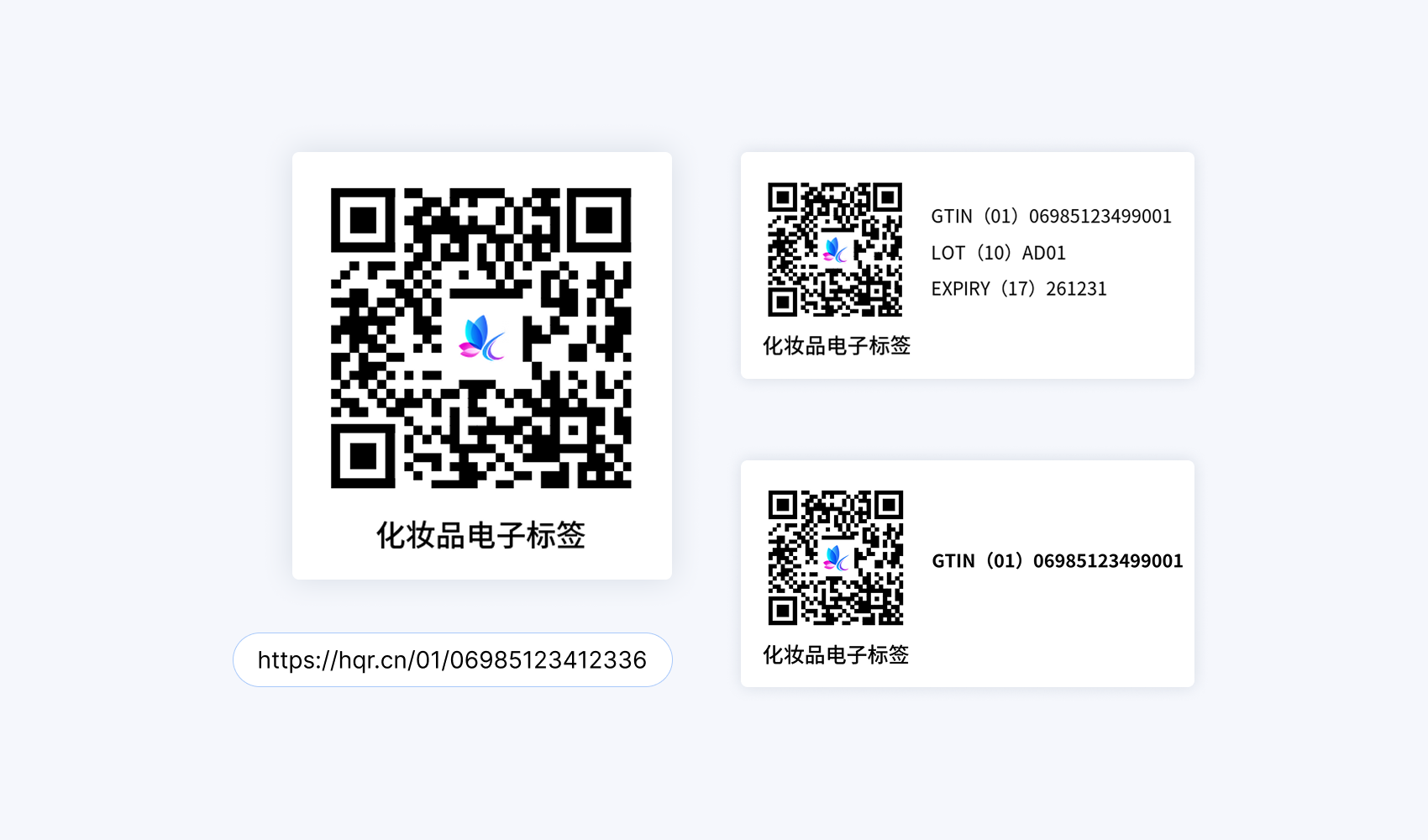
| Option 1: "See sales packaging" (the starting choice for most companies) | The QR code contains only the product identifier (one code per product), and the matching fields on the page say "See sales packaging" | One category needs only one fixed QR code printed on the packaging, with no need to modify the production line's code assignment |
| Option 2: one item one code / one batch one code | Prepare specific data such as production date and batch number and generate matching QR codes in bulk | You already have batch-level or item-level printing and code assignment capability and need to show batch information precisely |
3. Notes
- What is shown after scanning must be displayed directly, with no added conditions (such as following an Official Account) and no pop-ups that affect reading;
- You can use redirect links to show product anti-counterfeiting, traceability, and links to the product's official website promotional pages on a secondary page after scanning, but it must be clearly marked "The content shown on this page is not part of the cosmetics electronic label information and is the company's own responsibility".
4. What Information the Physical Packaging Must Keep
The electronic label doesn't replace all physical labeling. Under the rules, for products using an electronic label, the visible side of the sales packaging must show at least the following in standard Chinese characters:
- Chinese product name, special cosmetics registration certificate number
- Registrant or filer name
- Net content
- Period of use (production date + shelf life, or production batch number + expiry date)
- Safety warning statements (only small products with a net content of 15 g or 15 ml or less may omit the safety warning from the physical label, though it must be in the electronic label)
- Children's cosmetics must show the children's cosmetics mark
5. Printing Requirements for the Electronic Label
After generating the QR code label, when applying it to physical packaging design, follow these rules:
1. Mandatory Text Marking
Below the QR code, the words "Cosmetics Electronic Label" must be marked in a prominent font (for toothpaste, "Toothpaste Electronic Label"), clearly legible.
You cannot print only a QR code without that wording.
2. Size and Position Requirements
- Size: in principle no smaller than 9 mm × 9 mm
- Clarity: printed clearly and stuck firmly, avoiding recognition problems caused by packaging creases or deformation
- Position: a prominent position on the visible side of the sales packaging; where there is a Chinese label, mark it in a prominent position on the Chinese label
Reminder: if the packaging is small (such as eyebrow pencils and eyeliners), be sure to do a print test to make sure the QR code can be recognized smoothly by phones.
CaoLiao QR Code provides electronic label styles that meet the specification, which you can use directly, and after choosing a suitable label size and downloading, they are ready for printing.
6. Filing on the Regulatory Platform
After generating the electronic label QR code on the CaoLiao QR Code platform and finishing the packaging design, you need to upload the relevant information on the Cosmetics Registration and Filing Information Service Platform before the product goes on sale.
Materials to Submit
- Electronic label URL data structure encoding information: must go down to the product identification unit and be generated as required by the Technical Specification for Cosmetics Electronic Label QR Codes (Annex 3).
- Electronic label display content
- Product sales packaging images: must include a packaging image marked with the electronic label QR code
Change Management
If electronic label information changes, the relevant information for the changed electronic label must be submitted again on the platform before the cosmetics using the changed electronic label go on sale.
7. FAQ
1. After using an electronic label, what information must the physical packaging still keep?
The visible side of the sales packaging must still show six kinds of content in standard Chinese characters: Chinese product name and special cosmetics registration certificate number, registrant or filer name, net content, period of use, safety warning statements, and the children's cosmetics mark (if applicable). Small products with a net content of 15 g or 15 ml or less may omit the safety warning from the physical label, but it must be in the electronic label.
2. Should I build the electronic label system myself or use a third party?
It mainly depends on two things: whether you have ongoing development and long-term operations capability, and whether you need deep integration with existing systems. Companies without a development team that want to finish the application quickly suit a third-party system (such as CaoLiao QR Code); companies that need deep integration with ERP and production-line code assignment or have data autonomy requirements should evaluate building it themselves or an API integration plan. Either way, the registrant or filer always bears primary responsibility for the electronic label's content; if a third-party system is used, an agreement must be signed with the technical institution that includes accepting extended inspections by the drug regulatory authority.
3. What should I do when electronic label information changes?
Before the cosmetics using the changed electronic label go on sale, upload the relevant changed electronic label information on the Cosmetics Registration and Filing Information Service Platform. For the specific steps of editing electronic label content on the CaoLiao QR Code platform, see the Cosmetics Electronic Label System Setup Tutorial.
8. Related Content
- Cosmetics electronic label solution: scope of capabilities, service process, and purchase notes
- Cosmetics Electronic Label System Setup Tutorial: the complete steps to create, activate, lock, and download labels on the CaoLiao QR Code platform
- Shihuanuo pilot case: a first-batch pilot company in Guangdong Province, passing official review in 1 working day
If you are organizing materials or unsure which code generation method to use, you can contact a CaoLiao QR Code technical consultant, who can provide implementation support based on your actual management situation.