Agricultural Product Compliance Certificate: Label Stock Print Test Review
I. Label Stock Material Properties
1. Three-Protection Thermal Paper
Also known as "three-protection thermal label paper," "three-protection thermal self-adhesive," etc.
Three-protection thermal paper has some resistance to water, oil, and abrasion. Its substrate is still paper, just with a protective coating added to the surface, so it retains some of the drawbacks of paper — such as being tearable and prone to falling apart when soaked in water.
Advantages:
- Lower cost — it is the most affordable type of label stock. The cost per 30×20mm label is only about 1–2 fen.
- In dry or mildly humid usage environments, everyday exposure to moisture or light touching generally does not affect print clarity or scan readability.
Disadvantages:
- Limited tear and scratch resistance; in situations involving hard scratches, prolonged water or oil immersion, the label may be damaged.
- Uses thermal coloring, so print longevity is limited. Under normal conditions — away from direct light, in a dry environment — it can typically meet usage needs for up to one year.
Recommended Use:
Suitable for agricultural products with short shelf lives such as vegetables, fruit, and poultry eggs distributed through supermarkets and retail chains, where transport and storage environments are relatively controlled and labels can remain legible throughout the active usage period.
2. Five-Protection Thermal Synthetic Paper
Five-protection thermal paper typically uses PP or PE synthetic paper as its substrate. Compared to three-protection thermal paper, it performs better in terms of structural strength and environmental adaptability.
Advantages:
- Notably better tear resistance, scratch resistance, waterproofing, and oil resistance compared to ordinary three-protection thermal paper.
Disadvantages:
- Higher cost than three-protection thermal paper — the cost per 30×20mm label is about 4–6 fen.
- As it still uses thermal coloring, print longevity remains limited. Under normal conditions, it is primarily used for applications with up to a one-year usage cycle.
Recommended Use:
Suitable for agricultural products stored or transported in more complex environments with some humidity or friction, as a well-balanced general-purpose option between stability and cost.
3. Frozen Thermal Synthetic Paper
Also known as "low-temperature-resistant five-protection thermal paper."
The main difference between this type and ordinary five-protection thermal synthetic paper lies in the adhesive used — it is typically equipped with a low-temperature freezing-grade adhesive, which maintains good adhesion performance under low-temperature conditions.
Different specifications and grades are available on the market depending on freezing temperature requirements and actual labeling conditions.
Two Key Indicators to Focus on When Purchasing:
- Labeling temperature: The ambient temperature at which the label is applied. Most products require labeling at -15°C or above.
- Application environment temperature: The temperature conditions during actual use and storage. Common specifications include -18°C, -28°C, and -40°C — select based on your refrigeration or freezing requirements.
Recommended Use:
Suitable for cold-chain scenarios involving refrigerated or frozen agricultural products such as meat and seafood.
4. Thermal Transfer Synthetic Paper + Thermal Transfer Printer
The main difference between this solution and thermal paper is the printing method. It uses a thermal transfer printer with a ribbon. During printing, the ink on the ribbon is transferred to the label stock surface under heat to form the print.
Advantages:
- High print stability — not dependent on thermal coloring. Under normal conditions away from direct light, provides good resistance to water, oil, and sunlight. Suitable for applications requiring long-term information preservation.
Disadvantages:
- Higher overall cost — requires purchasing both label stock and a compatible resin ribbon. The cost per 30×20mm label (including ribbon) is about 1–2 fen.
- Printing operation is more complex than thermal printing.
Recommended Use:
Suitable for dried goods, tea, nuts, and similar products, or scenarios where labels need to remain clearly legible on a shelf for an extended period.
5. Coated Paper + Thermal Transfer Printer
Uses coated paper as the substrate, printed using a thermal transfer printer with a mixed-base ribbon. The ink on the ribbon is transferred to the coated paper surface under heat to form the print.
Advantages:
- The paper surface is smooth with high whiteness, producing clear and detailed text and images.
- In dry environments free of moisture, print performance is stable. Overall cost is lower than synthetic paper thermal transfer solutions, but still higher than thermal printing.
Disadvantages:
- Coated paper has a paper substrate that is not water-resistant or oil-resistant. In wet, spray, or oil-exposed environments, it can absorb water, wrinkle, and affect print quality and adhesion.
- Also has limited tear resistance and scratch resistance — not suitable for complex environments.
Recommended Use:
Suitable for dried goods in dry environments, short-term display, or indoor use scenarios — such as tea and nuts stored dry inside packaging where the label does not directly contact moisture or oil. Not recommended for refrigerated, frozen, or high-humidity environments.
II. Real-World Test Results by Brand
Before practical use, we tested the top-selling brands of label stock on JD.com and Taobao. The tests covered various adhesion surfaces (such as cardboard boxes, foam boxes, PET plastic packaging boxes, and plastic bags), and simulated water exposure, oil exposure, and friction conditions. The following is a summary of the test conclusions.
Note: The label size used in testing was 30×20mm.
CaoLiao has compiled recommended label printers and label stock for different types of agricultural products in various environments — click to view the quick-match guide.
1. Test Results at a Glance
Room Temperature + Dry Environment + Short-Term Use
| Recommended material | Brand | Cost per Label | Test Summary | Test Label Stock |
|---|---|---|---|---|
| Three-protection thermal paper | Nuoma | ≈1.3 fen | Stable adhesion on cardboard at room temperature; waterproof for everyday use; light scratches do not cause ink loss; heavy scrubbing causes ink loss | Same product link |
| Three-protection thermal paper | Xinwei | ≈1.4 fen | Stable adhesion at room temperature | Same product link |
| Three-protection thermal paper | Deli | ≈2.6 fen | Normal scan readability for short-term use at room temperature | Same product link |
Under the same room-temperature dry conditions, all brands and materials perform reliably. With quality assured, three-protection thermal paper is the more recommended option due to its lower cost.
Room Temperature + Wet / Oily Environment + Short-Term Use
| Recommended material | Brand | Cost per Label | Test Summary | Test Label Stock |
|---|---|---|---|---|
| Five-protection thermal synthetic paper | Nuoma | ≈3.8 fen | Synthetic paper substrate; stable water and oil resistance | Same product link |
| Five-protection thermal synthetic paper | Deli | ≈5 fen | Passed waterproof and oil-resistant tests | Same product link |
| Five-protection thermal synthetic paper | Laite Laili | ≈9 fen | Stable water and oil resistance | Same product link |
In wet/oily environments, three-protection thermal paper cannot be used — it will be damaged by water or oil exposure. For short-term use, five-protection thermal synthetic paper is the recommended choice.
Refrigerated/Frozen + Short-Term Use
| Recommended material | Brand | Cost per Label | Test Summary | Test Label Stock |
|---|---|---|---|---|
| Five-protection thermal synthetic paper | Nuoma | ≈3.8 fen | Applied using a label-first-then-freeze method; no significant peeling or lifting after freezing | Same product link |
| Five-protection thermal synthetic paper | Nuoma | ≈5.8 fen | Low-temperature adhesive solution; maintains adhesion in low-temperature environments | Same product link |
| Five-protection thermal synthetic paper | Meidike | ≈9 fen | Stable adhesion in frozen environments; suitable for short-term cold-chain labeling | Same product link |
For refrigerated/frozen environments with short-term use, the first choice is five-protection thermal synthetic paper with low-temperature freezing adhesive. CaoLiao's testing could not reach extreme low temperatures — when purchasing, confirm the usable temperature range with the seller.
High-Frequency Friction + Long-Term Use
| Recommended material | Brand | Cost per Label (including ribbon) | Test Summary | Test Label Stock |
|---|---|---|---|---|
| Thermal transfer synthetic paper | Avery | 1.5 fen | Waterproof and oil-resistant; does not easily lose ink under heavy scratching; remains scannable after prolonged friction | Same product link |
For long-term use requirements, thermal label stock is no longer suitable. You will need a thermal transfer printer with thermal transfer label stock and a ribbon. When purchasing a printer, look for "thermal transfer printer"; when selecting label stock, look for "thermal transfer synthetic paper"; when choosing a ribbon, look for "resin ribbon."
2. Detailed Test Records
Three-Protection Thermal Paper (Thermal Printing)
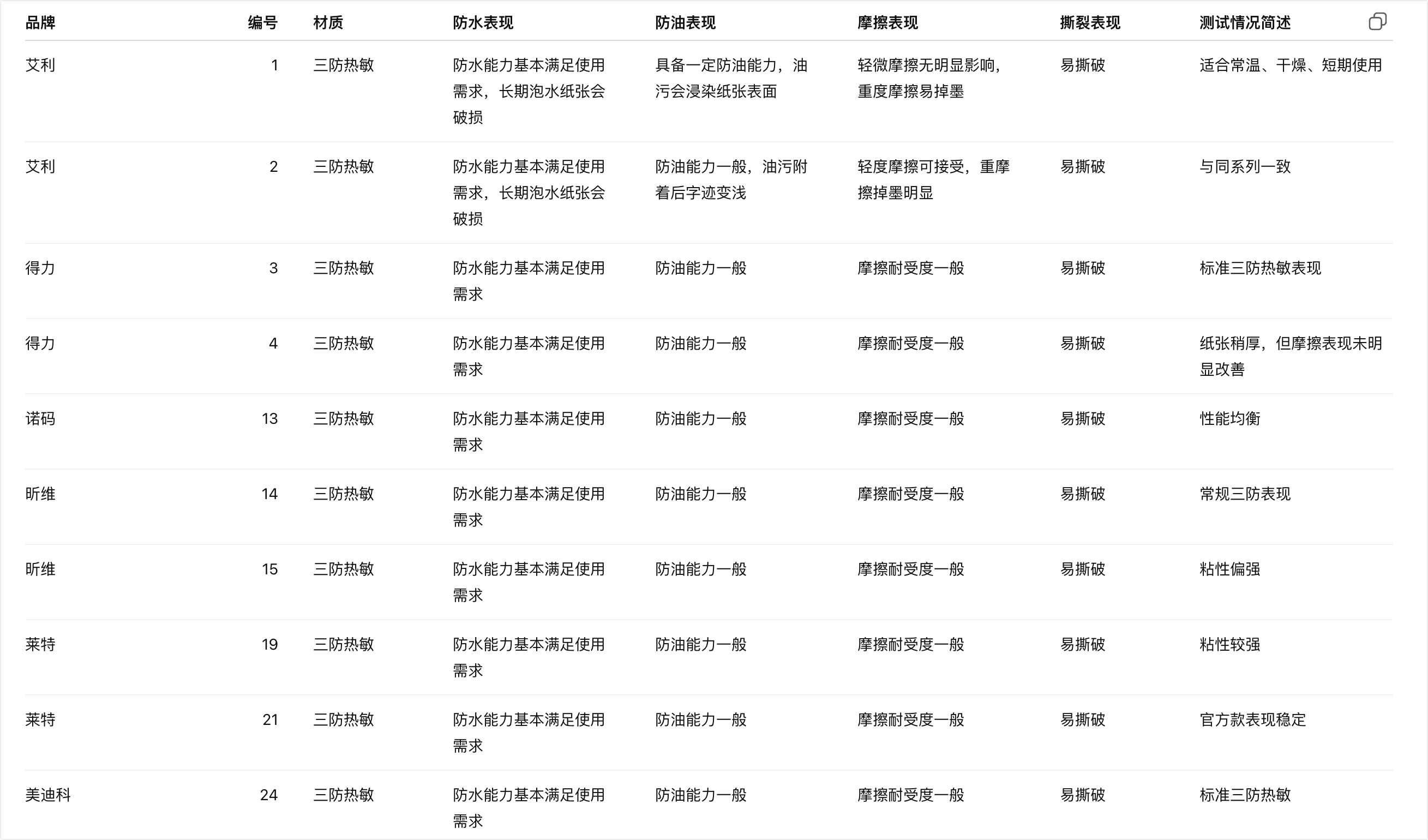
Three-protection thermal paper waterproofing capability meets short-term use requirements, but oil resistance and scratch resistance are limited — not suitable for long-term or complex environments.
Five-Protection Thermal Synthetic Paper (Thermal Printing)
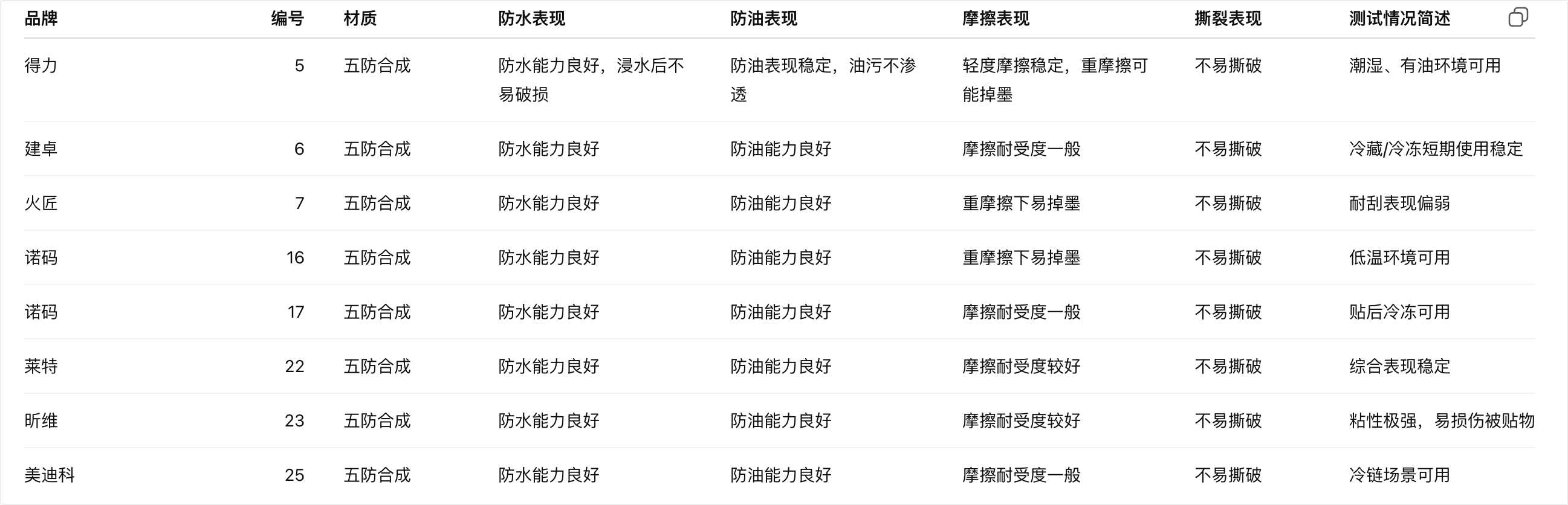
Five-protection thermal synthetic paper significantly outperforms three-protection thermal paper in waterproofing and oil resistance, but the thermal coloring method still carries a risk of ink loss under heavy friction.
Coated Paper & Thermal Transfer Synthetic Paper (Thermal Transfer)
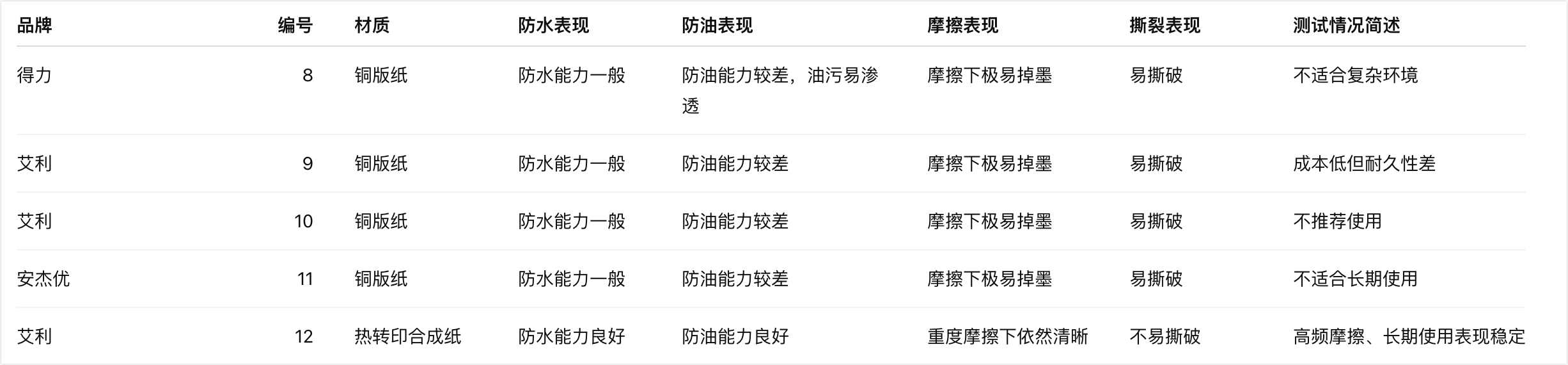
Coated paper has limited waterproofing, oil resistance, and scratch resistance — it requires a ribbon and has high cost; not recommended. Thermal transfer synthetic paper delivered the most stable durability test results — choose it if cost is not a concern.