No System Purchase, No IT Staff Needed: Build an Efficient Electronic Patrol Process with QR Codes
Original: https://cli.im/article/detail/2376
"Team Leader Wang, the fire equipment inspection records for Building 3 are missing again, and they were definitely checked last week!" complained Xiao Li from the property management company, anxiously flipping through the paper logbook. This scenario is all too familiar in places like hospitals, schools, shopping malls, and factories that require regular inspections—traditional manual patrol methods are gradually failing to meet today's management needs.
Paper records are easily lost, content is hard to verify, problem reporting is sluggish, and data compilation is time-consuming and labor-intensive. Although many organizations have started trying electronic inspection systems, most products on the market are expensive, come with complex specialized equipment, and are not easy to implement, especially for small and medium-sized institutions, where the barrier to entry is significant.
Is there a way to genuinely improve patrol record-keeping and management efficiency without significant additional investment? Many organizations have found a viable solution—the QR code-based patrol method offered by CaoLiao QR Code.
1. CaoLiao QR Code: A Lightweight and Easy-to-Use Patrol Tool
CaoLiao QR Code offers a flexible inspection approach: using a mobile phone to scan QR codes replaces traditional paper records. No complex equipment is needed; simply posting QR codes allows you to set up a clear and straightforward patrol process. This method is particularly suitable for organizations with limited budgets that still want to improve their management details.

1. Simple Deployment, Flexible Adjustments
Traditional electronic patrol systems require a fully planned route before deployment, and making changes afterward can be troublesome. The CaoLiao QR Code method is much more flexible:
- You decide where to place points: Place them wherever inspections are needed, starting with key areas and adding or removing points as needed.
- No additional equipment needed: Patrol personnel only need to use WeChat to scan the codes; their phones are the tools.
- Adjustments take effect immediately: Adding a point or modifying a form can be done the same day without technical support.
Mr. Zhang, a security supervisor at a chain supermarket, recalled: "We started by only placing codes on fire equipment. Later, we found that shelves and freezers also needed inspections, so we added over twenty points. The whole process was smooth and didn't require any technical expertise."
2. Traceable Inspection Records, Harder to Falsify
"Sometimes, records were neatly filled out even when no one had been on-site. We've encountered this before," many managers express concerns about the authenticity of records.
With QR code patrols, such issues are significantly reduced, thanks to these mechanisms:
- Location recording: Scanning is restricted to specific location ranges, ensuring personnel actually reach the patrol points.
- Mandatory on-site photo uploads: Photos must be taken on the spot; selecting old photos from the gallery is not allowed.
- Scanning restrictions: Long-press recognition to fill out forms is disabled; on-site scanning is required.
A director from the equipment department of a tertiary hospital shared: "After using QR codes, our equipment inspection completion rate increased from 70% to 98%. Every record includes photos and location data, making responsibility clearer when troubleshooting."
3. Streamlined Exception Handling
Identifying issues is only the first step; how to handle them and track progress has often been lacking in the past. Now, using QR codes with forms enables a clear closed-loop process:
- Report issues directly by scanning the code, eliminating the need for phone calls or notes.
- The system automatically notifies preset responsible persons, bypassing manual relaying.
- On-site personnel can @ others for collaborative handling, making communication more direct.
- The handling process can include text and images, leaving a clear trail.
- Issues are confirmed as resolved, ensuring clarity in responsibility and progress.
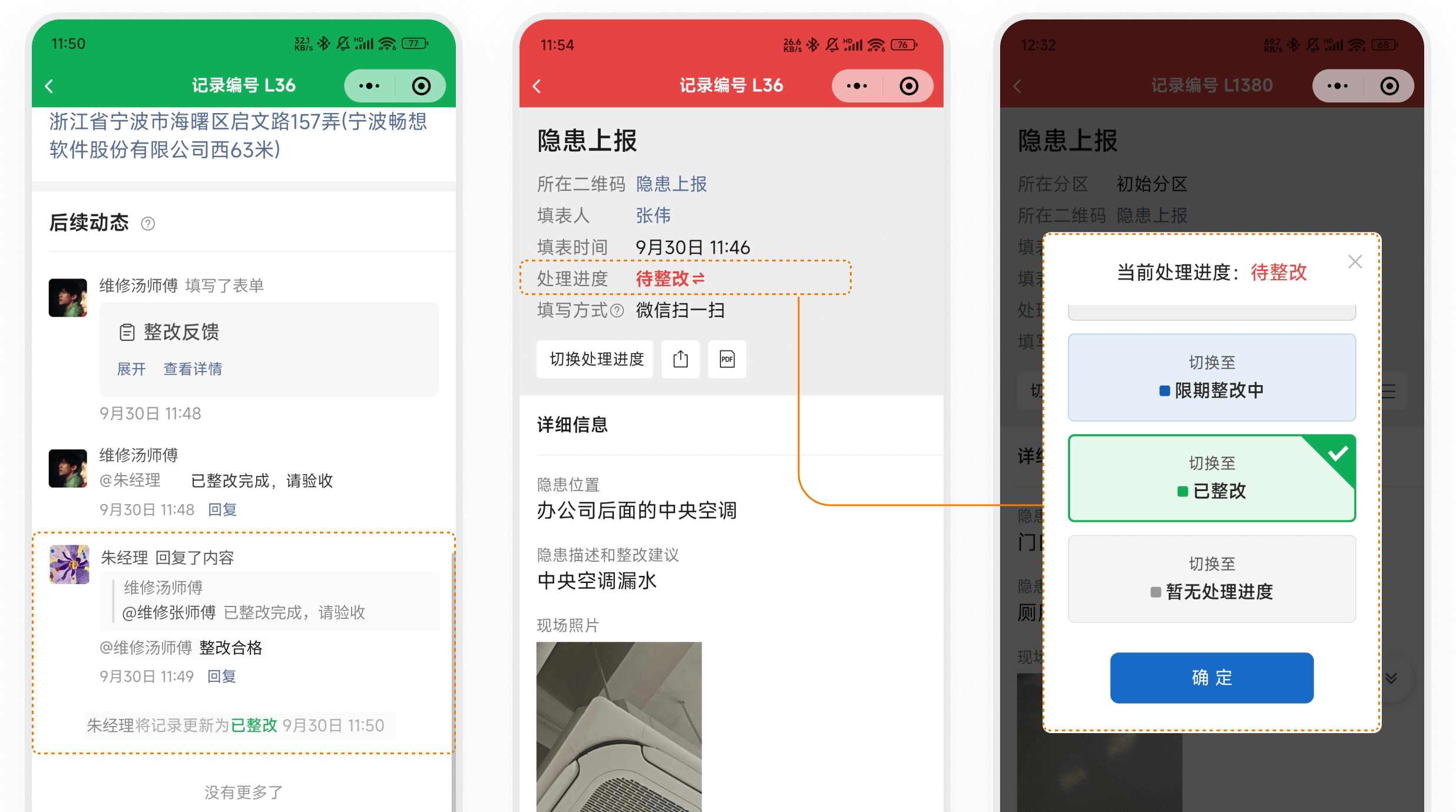
A property manager at an industrial park reported: "Previously, when equipment had issues, we had to fill out forms, notify people, and wait for responses. Now, scanning the code on-site notifies the maintenance team in under a minute, and we can track the status on our phones. Efficiency has multiplied."
4. Work Zoning, Clear Permissions
Patrol work often involves multiple people, especially in scenarios like parks and factories. The CaoLiao QR Code system supports:
- Partition management: Different areas can be assigned to different personnel.
- Clear role permissions: Patrol personnel, maintenance staff, and administrators have distinct permissions, clarifying who can fill out and view records.
- Internal use restrictions: The system can be set to allow only internal accounts to operate, avoiding external interference.
5. Convenient Data Querying, No More Manual Calculations
Patrol data is stored in the backend, eliminating reliance on paper records or manual compilation. Administrators can:
- Retrieve records anytime: Filter by area, personnel, or time for easy access.
- Export for analysis: Export data to Excel or integrate with existing reporting systems when needed.
A school logistics supervisor shared: "Previously, checking how many times a piece of equipment had been repaired meant flipping through several logbooks. Now, a quick computer search tells us the repair date, who handled it, and how it was resolved. It's much more convenient."
2. Building from Scratch Isn't as Complicated as You Think
Setting up a patrol system with CaoLiao QR Codes is straightforward, roughly following these steps:
- Organize information and store it in Excel.
- Use bulk templates to generate QR codes with one-click import.
- Print and post the QR codes at corresponding locations.
- Set inspection requirements and reminders, including exception handling processes and personnel notifications.
- Train frontline personnel—it's as simple as "scan with WeChat and fill out the form."
These basic features are free, and many organizations can meet their daily patrol needs with just the free version. For those with more customization requirements, paid versions are available, offering features like system integration and API usage.
3. Real Cases: How Did They Do It?
Case 1: Security Patrols in a Shopping Mall
A large shopping mall in Beijing placed QR codes at 86 points, including fire exits, electrical equipment rooms, and key store entrances. Twenty security personnel conducted inspections in three shifts.
Post-implementation data changes:
- Patrol completion rate increased from 85% to 99.5%.
- Average exception response time shortened from 4 hours to 30 minutes.
- Monthly savings in labor costs for paper record-keeping and statistical work amounted to approximately ¥5,000.
Case 2: Campus Facility Maintenance
A middle school in Shanghai placed QR codes in classrooms, laboratories, playgrounds, and other areas. The logistics director stated: "Our maintenance workers are now accustomed to scanning codes for work. Equipment issues are handled more promptly, and complaints from students and parents have significantly decreased."
Case 3: Equipment Spot Checks in a Manufacturing Plant
A manufacturing company in Guangdong placed QR codes on over 200 production equipment units. Workers scan the codes for daily pre-operation checks. The plant manager noted: "We tried other systems, but they were too complicated and no one used them. The QR code method is simple and clear, and even veteran workers in their fifties find it easy to use."
4. Why Choose QR Codes Over Large Systems?
Compared to traditional electronic patrol systems, lightweight solutions like CaoLiao QR Code offer several key advantages:
- No reliance on technical staff: The setup process is entirely visual and can be handled by administrative personnel.
- Low cost: Basic features are free, and paid options are far cheaper than traditional systems.
- Start small, expand flexibly: Implementation can be gradual, avoiding the need for an "all-at-once" approach.
- Continuous improvement: The platform regularly updates details based on user feedback, maintaining practicality and ease of use.
A property manager put it succinctly: "We tried several patrol tools and ultimately chose CaoLiao QR Code. Not because it has the most features, but because it fits our actual scenario perfectly—not complicated, but effective."
5. Returning Patrols to Their Original Purpose
At its core, patrolling isn't about having a fancy system or complex processes. The goal is to clarify responsibilities, identify issues, and resolve them promptly—not to get bogged down in form-filling and formalities.
The QR code method isn't a groundbreaking innovation, but it simplifies something that has been overcomplicated, making it clear and practical again. For many organizations, that's exactly what's needed.
You can start with a dozen key points and spend an afternoon setting up your own electronic patrol system. Post the QR codes, scan them, and you'll know whether inspections were done, what was inspected, and what was found.
It might be simpler than you think.