Application of QR Codes in Cement Industry Equipment Management
Original: https://cli.im/article/detail/2356
From the perspective of equipment management in cement enterprises and based on actual production conditions, this article promotes the application of "Equipment QR Codes," using equipment electronic tags as a breakthrough point to introduce equipment management work under new circumstances.
I. The Significance of Effective Inspections and Current Equipment Management Analysis
Cement production enterprises have a wide variety and large quantity of equipment, with closely interlinked production processes. Particularly, there are many large or heavy-duty devices, with ball mills, vertical mills, and rotary kilns at the core. These equipment are highly interconnected; whether it's a production issue or an equipment problem, it can cause parameter changes across the entire line. Any delay in addressing potential hazards can affect the normal production of related areas or even the entire line, potentially causing personal injury. This hinders the achievement of long-term stable production and impacts enterprise production efficiency. Through continuous and effective inspections, equipment can maintain stable operation over long periods, reducing enterprise equipment maintenance costs, production costs, and equipment inventory. Therefore, effective inspections are fundamental systems and rules that must be adhered to in the cement industry.
Our company is a traditional cement and concrete processing and manufacturing enterprise. Equipment inspections mostly follow traditional models, namely a three-level inspection and hierarchical management system.
(1) On-site personnel inspect all equipment, primarily using hearing, smelling, looking, and touching to make preliminary judgments on abnormalities in equipment sounds, odors, appearance/color, vibrations, etc.
(2) Workshop-level specialized inspections focus on key equipment such as ball mills, vertical mills, rotary kilns, roller presses, and various large oil stations, relying mainly on instrument measurements of vibration values, temperature values, pressure values, current values, voltage values, etc.
(3) Plant-level random checks involve monthly reviews organized by plant management and technical personnel, focusing on re-examining the inspection status of on-site personnel and specialized inspectors, actual equipment operation conditions, and recorded inspection parameters. This serves as the basis for formulating monthly equipment maintenance plans and assessing relevant inspection personnel.
Previously, inspection personnel conducted inspections according to the time stipulated by regulations, recorded them in inspection logs, and archived them. Equipment ledgers, lubrication ledgers, and inspection ledgers were manually recorded. In recent years, to improve equipment management levels, investments in equipment management hardware have increased, installing some fingerprint scanners, surveillance cameras, inspection instruments, patrol wands, etc. Practice has shown that each has its pros and cons.
(1) Fingerprint Scanners + Inspection Logs: Installing fingerprint scanners near some critical equipment; inspectors scan their fingerprints during inspections as unalterable proof. Drawbacks include: a) poor on-site environments leading to low sensitivity and high failure rates of fingerprint scanners; b) numerous devices mean scanners can only be installed per area, not per device, and cannot guarantee inspectors genuinely and effectively check the equipment.
(2) Surveillance Cameras + Inspection Logs: Installing cameras at key equipment points to transmit inspection images. Drawbacks include: inability to cover all devices with cameras due to their quantity, and the high workload, time consumption, and inefficiency of reviewing footage.
(3) Inspection Instruments + Patrol Wands: The inspection instruments and patrol wands used in recent years enable the transmission of real data. Drawbacks include: these specialized devices only transmit vibration data for some key equipment and cannot monitor equipment appearance or real-time images.
In ledger management, including equipment ledgers, lubrication ledgers, inspection ledgers, and maintenance record ledgers, manual entry is primarily done by specific equipment responsible persons. In practice, this also has many shortcomings.
In summary, the handheld device inspection + paper record model mainly has the following shortcomings:
(1) High procurement and maintenance costs for handheld inspection terminals. (2) Inconvenient querying of equipment archives. (3) Inspection records can only be described in text. (4) Grassroots personnel inspect, middle-level personnel input data; hierarchical reporting is inefficient. (5) Equipment status updates are not timely; fault reporting lags. (6) Inability to effectively supervise the actual inspection activities of personnel. Traditional inspections have many drawbacks; handwritten data is highly subjective and prone to misreporting, false reporting, and data fabrication. Inspection logbooks need to be created separately for different areas or even different devices. Each inspector typically needs their own logbook; otherwise, it affects other inspectors' efficiency. Inspectors cannot view accurate parameter information for the equipment being inspected, relying instead on memory, which varies by person and yields inconsistent results. Subsequent archiving and querying are also time-consuming and laborious. Contradictions arise in evaluation and error correction: if the logbook appears too clean, it's often suspected of data fabrication without genuine on-site recording; if it's too dirty, it's unsuitable for long-term archiving or review.
II. Application of Equipment QR Codes
Compared to paper-based inspections or equipment inspection management systems, the QR code equipment inspection method is more suitable for lightweight to medium-weight information management. Firstly, QR code inspections are no longer merely equipment checks; scanning the code allows access to each individual device's nameplate, photos, manuals, parameters, drawings, maintenance/replacement records, etc. Thus, it has evolved into a small-scale information management system.
The QR code + WeChat Mini Program solution can significantly reduce the difficulty of implementing inspection informatization. It requires no additional equipment purchases or employee training; all inspection work is completed within the mobile WeChat app. It is low-cost, easy to use, and simple to deploy. By providing a series of technical means—from QR code generation and management to cloud data processing—it greatly lowers the usage threshold and management costs.
Compared to the traditional handheld device inspection + paper record model, QR code inspections offer the following advantages:
(1) No software installation required; just scan the code with a phone. (2) The QR code serves as the equipment's ID card; scanning with a phone allows viewing of equipment information archives and inspection records. (3) Supports recording on-site真实情况 through photos and videos. (4) Inspection records are formatted, standardizing check items; data is digitized and cannot be manually altered. (5) Fault conditions can trigger real-time notification pushes. (6) Ensures data record authenticity through methods like GPS location and photo anti-counterfeiting.
The specific operational workflow for QR code inspections is as follows:
1) Plant Specialists Generate QR Codes
Dedicated equipment management personnel in the company use the CaoLiao QR Code platform to batch-generate QR codes for each individual piece of equipment on the production line. These are uniformly printed into QR code labels and affixed to conspicuous locations on the corresponding equipment surfaces. The backend can link to the equipment's original technical ledgers, such as nameplates, parameters, manuals, drawings, and maintenance records. Scanning the code with the WeChat mobile app allows access to all technical archives.
2) On-site Personnel Implementation Steps and Methods
On-site inspection personnel use their mobile phones to scan the equipment QR code at the device requiring inspection. This automatically redirects them to the inspection interface. Here, they can fill out an electronic form (see Figure 1) according to predefined prompt titles, recording various operational data for the equipment. They confirm each pre-set inspection item one by one and take photos of the on-site situation. If equipment abnormalities are found, they can report them by scanning the code, and the system will automatically notify relevant personnel. Both the repair request and the repair process can be recorded and archived via scanning, facilitating more targeted fault analysis and preventive maintenance later.
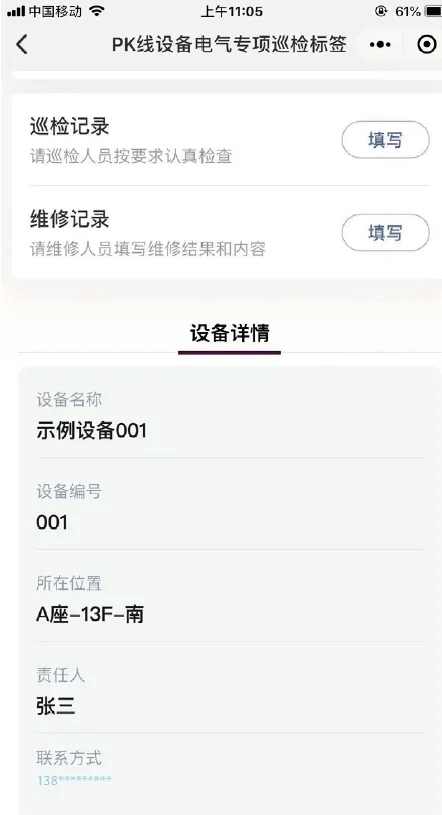 Figure 1: Filling out the record
3) Implementation of Internal Management Solutions
Internal collaboration and closed-loop control can be directly facilitated using mobile phone sharing. The plan management function can achieve regular inspection management. The equipment status dashboard allows managers to have a global grasp of equipment operation status.
QR codes can effectively prevent fake inspections by restricting geographical locations, requiring online photo capture (disallowing uploads from the gallery), and applying blockchain notarization to each record, thereby constraining and standardizing the work processes of on-site inspectors. Record data is stored on cloud servers. Subsequently, this data can be connected to third-party tools for further display or analysis, or pushed via API to the enterprise's internal management system, uploading data from various sources to the server. The application interface is shown in Figure 2, and the form association application is shown in Figure 3.
 Figure 2: Application Interface
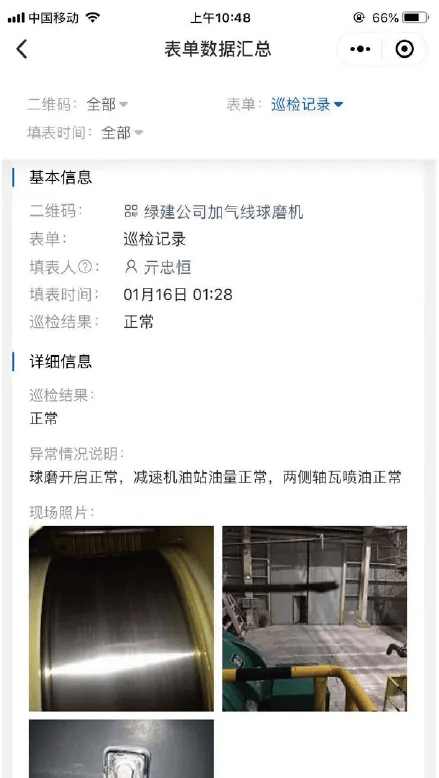 Figure 3: Form Association Application
III. Conclusion
After nearly three months of use, feedback on the effectiveness of QR code inspections has been positive. They can replace all paper-based records and ledgers related to equipment management, realizing paperless office operations for equipment management. QR codes enable the implementation of standardized and institutionalized regulations derived from experience. They achieve more refined on-site management for record checks and equipment inspections, improving management efficiency and effectively enhancing personnel's sense of responsibility. Furthermore, the QR code solution provides a technological platform that allows for deeper exploration of internal potential, not only in equipment management but also in safety management, personnel attendance, fire safety management, raw material procurement, maintenance logistics, and any other area requiring IoT connectivity, enabling颠覆传统的高效率办公 (disruptively efficient office work compared to tradition).
Original article reprinted from the WeChat Public Platform: Cement 《Technology | Application of QR Codes in Cement Industry Equipment Management》