Why Small and Medium Enterprises Struggle with the Cost of "Large-Scale Systems"
Original: https://cli.im/article/detail/2445
In recent years, ERP, MES, PLM, and other "large-scale systems" have almost become synonymous with digital transformation in manufacturing enterprises. At numerous industry conferences and in media reports, these systems are portrayed as essential pathways for companies to enhance efficiency and advance toward smart manufacturing. However, for the vast number of small and medium-sized manufacturing enterprises (SMEs), reality is often far harsher than the blueprint: they recognize the value of these systems but find it difficult to bear the heavy investment required.
This is not merely a financial issue; it is a structural contradiction between the operational methods and developmental stages of SMEs and the requirements of "large-scale systems."
1. Investment Exceeds the Capacity of SMEs
The most obvious barrier is price. A relatively standardized ERP system can cost anywhere from tens of thousands to millions, while customized MES solutions are often even more expensive. For a large manufacturing group, such an investment is just a fraction of the annual budget. But for a small or medium-sized factory with an annual output value of a few tens of millions and low profit margins, this is almost a "bet-the-company" decision.
Moreover, costs do not stop at the "purchase" stage. Implementation, training, maintenance, and secondary development all represent ongoing expenses. Many factory owners start projects with high hopes, only to discover later that less than one-fifth of the system's functions are actually usable, while the rest become a heavy burden.
| Comparison Item | Large-Scale Systems (ERP/MES) | QR Codes (CaoLiao QR Code) |
|---|---|---|
| Deployment Cost | Tens of thousands to millions | Free to use, maximum under ¥20,000 |
| Implementation Time | Six months to over a year | Minutes to weeks |
| Learning Curve | High, requires specialized training | Low, if you can use WeChat, you can use it |
| Flexibility | Low, often requires custom development | High, adjustable anytime, real-time updates |
2. Implementation Timelines Are Out of Sync with Business Realities
The rollout of large-scale systems often takes months or even over a year. From requirement analysis and solution design to testing and implementation, each step requires time and human resources. For resource-constrained SMEs, such a timeline means missing opportunities to respond quickly to market changes.
For example, an automotive parts supplier in the Yangtze River Delta region once planned to introduce an MES. They invested significant time upfront in designing the solution, but six months later, customer demands shifted, and order structures changed accordingly. Before the system could even be fully implemented, the company was already facing new challenges. For them, adaptability is more critical than large-scale systems, which clearly struggle to keep up with such rapid changes.
3. High Barriers to Usage, Difficult to Adapt at the Frontline
Even if a company grits its teeth and implements a system, it often faces the dilemma of "system underutilization." The reason is that large-scale systems are typically designed for management, with numerous features and complex logic. However, the needs of frontline workers are simple and straightforward: scan, register, and leave a trace.
In SMEs, frontline workers often have high turnover rates and varying educational backgrounds, making training and execution costs persistently high. The workshop environment is noisy, and workers' hands are often dirty, making complex system terminals impractical. As a result, while management hopes to use the system to collect data, frontline workers continue to rely on pen, paper, and experience. Over time, the phenomenon of "dual record-keeping" becomes inevitable.
4. Lightweight Solutions: A More Realistic Path
As "large-scale systems" become an unbearable burden for SMEs, lightweight tools are gaining attention. The value of lightweight solutions lies in addressing the most urgent pain points with low cost and low barriers to entry, then gradually expanding.
Compared to large-scale systems, lightweight tools offer several distinct advantages:
- Low Investment: Deployment costs are less than one-tenth of an MES, or even lower.
- Short Implementation Time: Rollout in days, not months or years.
- Quick Adoption: Leveraging intuitive methods like mobile QR code scanning, requiring almost no additional training.
- Scalability: Companies can start with one scenario and gradually expand coverage as needs grow.
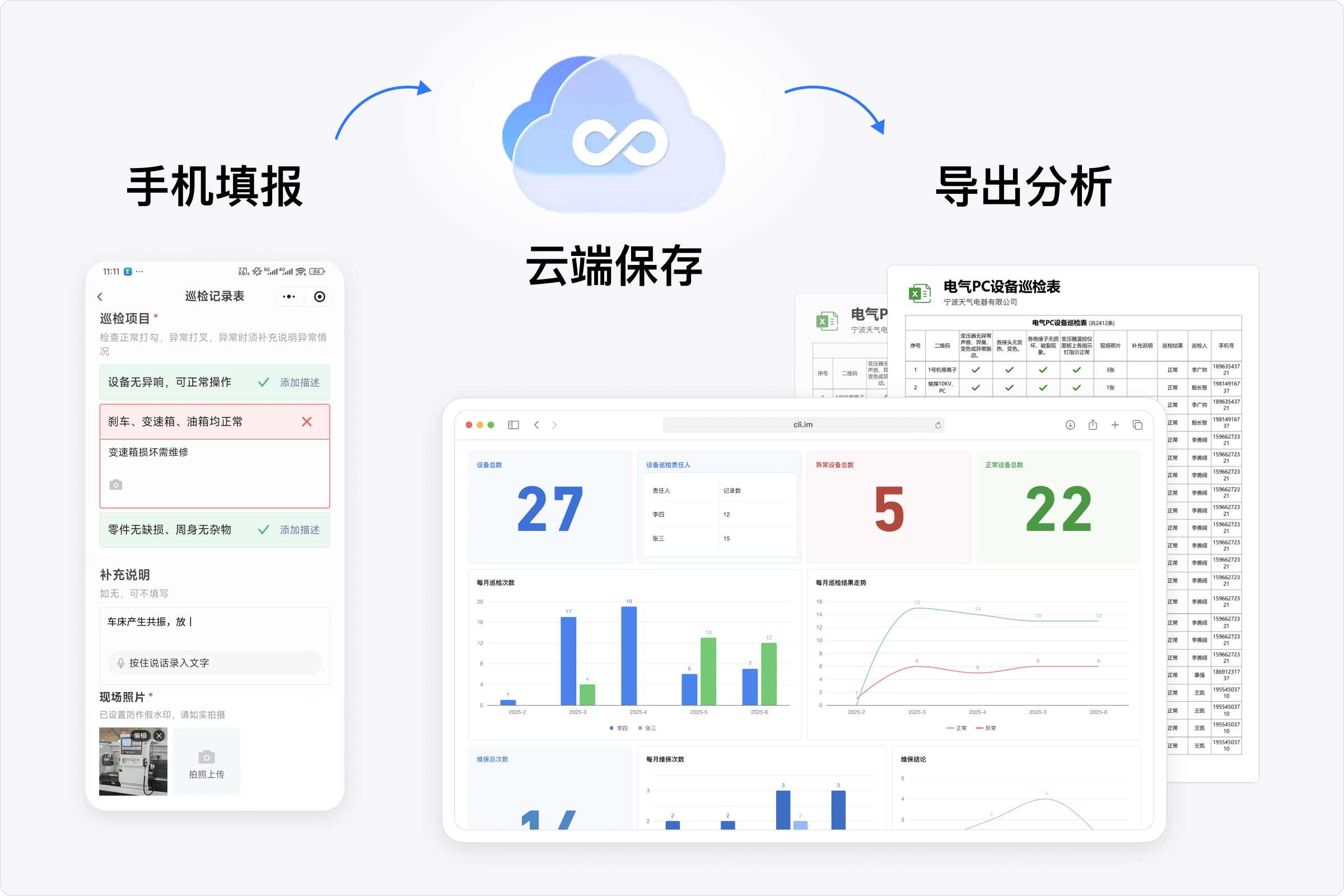
Among various lightweight tools, QR codes are one of the most popular and fastest-to-implement solutions. By placing QR codes on equipment, work badges, or materials, workers can complete information entry and queries by scanning, without disrupting existing workflows or requiring additional hardware.
Platforms like CaoLiao QR Code now serve over 16 million users and have become the preferred choice for many SMEs. These tools are not meant to replace ERP or MES but to "fill the gaps" or serve as "lightweight alternatives," bringing digitalization directly to the frontline. Scenarios such as equipment management, personnel management, information display, and fire safety can all be rapidly digitized using QR codes.
5. A Case Study: Digitalization Through Small, Quick Steps
As a leader in the consumer electrical and electrical appliance sector, Bull Testing Center faced multi-dimensional quality assurance pressures—from equipment status monitoring to personnel management, and from document archiving to laboratory environment records. The tasks were heavy, yet they could not afford to neglect even minor details.
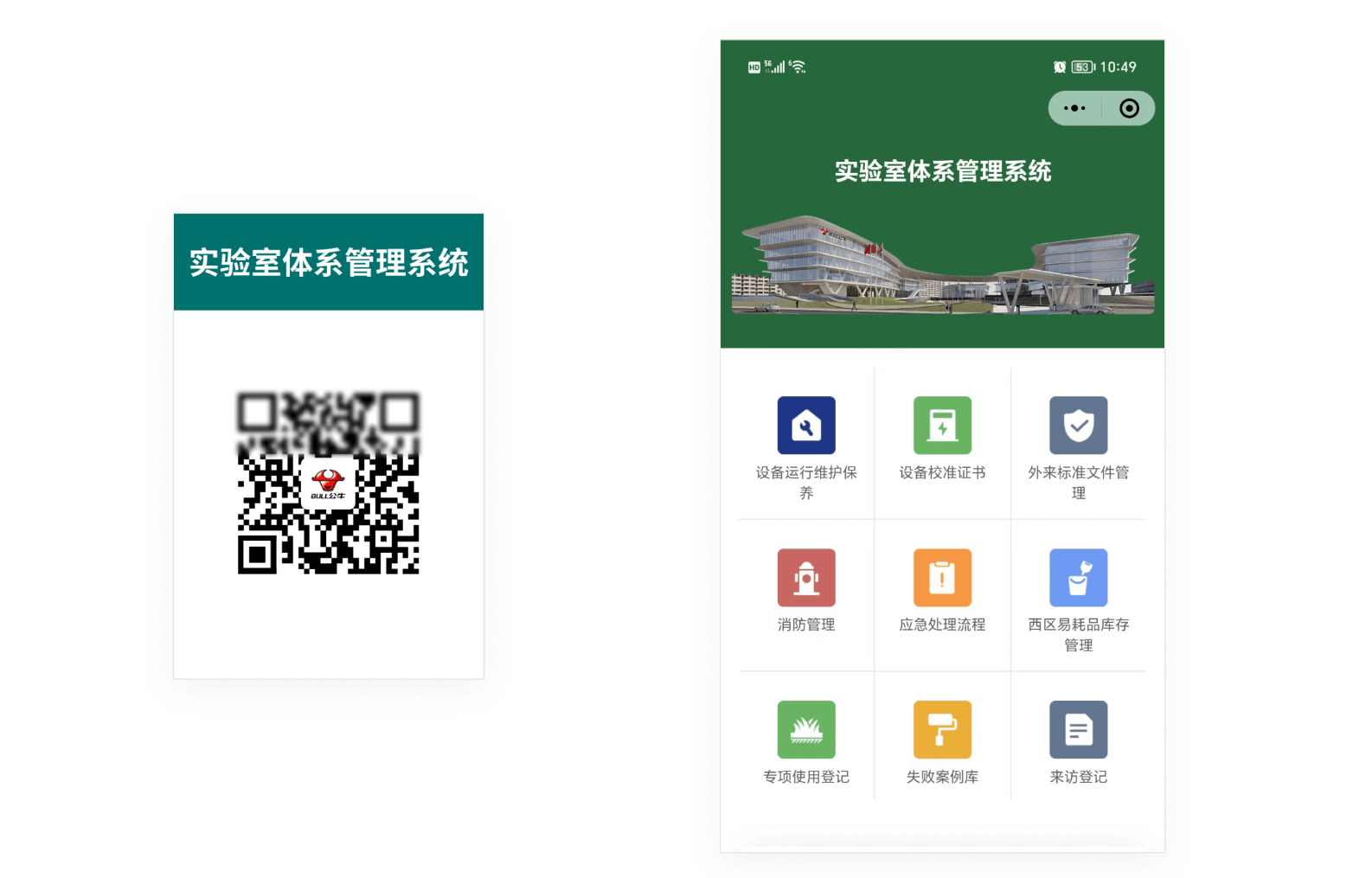
Instead of blindly investing in expensive MES projects, they built a "Laboratory System Management System" based on CaoLiao QR Code. With a total investment of less than ¥3,000, they achieved management results comparable to professional MES systems:
- Scan to Operate, Quick Adoption at the Frontline: Each piece of equipment and key point was labeled with a QR code. On-site personnel could simply scan the code with WeChat to enter information or view historical records. The process was intuitive, requiring no additional hardware or training.
- Rapid Implementation, No Waiting Required: From creating the codes to deployment, the system could be up and running in as little as 30 minutes. QR codes could be used immediately upon placement, in stark contrast to "waiting for system rollout."
- Flexible Expansion, Applicable to Multiple Scenarios: Various tasks, big and small, could be digitized using QR codes, such as visitor registration, consumables inventory management, and document management. Data was traceable and could be aggregated, supporting trend analysis and quality improvement.
6. Conclusion
For SMEs in manufacturing, digital transformation is a mandatory task, but it does not mean it has to be achieved all at once. While ERP and MES have their value, they are better suited for large enterprises with ample resources and mature management structures. If SMEs blindly pursue large-scale systems, they often end up with massive investments and limited returns, potentially even hindering their core operations.
A more pragmatic approach is to start small and gradually advance from the most critical areas. The value of lightweight tools lies in enabling SMEs to take the first step in digitalization with lower costs and faster implementation. Compared to pursuing "all-in-one" large-scale systems, "small solutions" that solve immediate problems and align with frontline habits are often the more appropriate answer.
In the future, those who can simplify complexity and transform high costs into tools accessible to all will earn the trust of SMEs and are more likely to succeed in the long run.