Back-to-School Season New Student Registration: Efficient QR Code Solution
Original: https://cli.im/article/detail/2432
Every September, whether it's universities, vocational schools, training institutions, or technical colleges, they all face one of the busiest periods of the year – new student registration. Facing hundreds or even thousands of new students, the complexity of enrollment registration far exceeds expectations. Beyond basic identity information collection, there are parent contact details, accommodation arrangements, payment information, health declarations, document submissions... numerous steps, varied content, and tight deadlines. A slight oversight can lead to omissions or repeated communication, impacting the entire enrollment process.
Previously, many schools relied on methods like on-site paper registration, WeChat group notifications, and Excel spreadsheet tracking to complete these tasks. However, in practice, these methods have increasingly revealed a series of problems. In recent years, some schools have begun turning to QR code tools, especially with the support of versatile digital platforms like CaoLiao QR Code, attempting to build more stable and efficient information registration processes.
This article will combine current mainstream practices and hands-on experience, outlining an information registration system suitable for the new student enrollment season from three dimensions: "Pain Points," "Solutions," and "Tool Practices," helping schools manage registration tasks more calmly during the peak back-to-school period.
I. Typical Problems Exposed by Traditional Methods
1. Scattered Forms, Repeated Entries
Different departments within a school (e.g., Student Affairs, Academic Affairs, Logistics) often distribute registration forms separately, leading to common issues:
- Inconsistent form formats across departments cause students to repeatedly enter the same information.
- Registration links are scattered across WeChat groups, QQ groups, or official account articles, making it difficult for students to complete the entire process at once.
- Forms lack skip logic or content validation, resulting in high error rates and requiring manual verification later.
2. Untimely Information Collection Affects Arrangements
Delays in registration information directly impact subsequent arrangements, such as:
- Inability to finalize dormitory assignments or statistical counts for military training uniform sizes on time.
- Failure to promptly grasp accommodation preferences or arrival schedules can lead to on-site chaos or resource waste.
- High time cost for manually categorizing, naming, downloading, and archiving received materials.
3. Over-reliance on Manual Processes for Registration Channels
Some schools still use paper registration combined with manual data entry, or send data collection tasks via WeChat/QQ groups, then manually organize emails or screenshots. Problems with this approach include:
- Prone to omissions and mix-ups.
- Lack of structured data makes it difficult to import directly into systems.
- Inability to uniformly monitor data entry progress.
- High human resource investment, especially when manpower is already stretched thin during the enrollment period.
II. QR Code Solution: Low Barrier, Fast Deployment, Clear Structure
The essence of the QR code solution is to streamline and structure the information collection workflow, using the low-barrier entry point of scanning a code to uniformly publish and collect information externally.
1. Why are QR Codes Better Suited for School Registration Scenarios?
- Unified Entry Point: All registration tasks are consolidated into one QR code or directory page. Scanning the code provides access to all necessary content, replacing the distribution of multiple links.
- Flexible Content Adjustment: Unlike one-time paper forms or official account articles, the content behind the QR code can be edited in real-time without affecting the user path for those who have already scanned it.
- Structured Data Collection: All submitted information is automatically aggregated into an online spreadsheet, downloadable as Excel, eliminating the need for manual summarization or transcription.
- Low Technical Barrier: Compared to building mini-programs or system integrations, QR code platforms generally require no development resources and are ready to use, fitting the practical operational capabilities of educational institutions.
2. The Practical Functional Value of CaoLiao QR Code in Registration Scenarios
As a versatile QR code content management tool, CaoLiao QR Code offers several capabilities applicable to new student registration scenarios:
- Supports various form components: Configurable fields include ID number, phone number, single choice, image upload, address selection, date and time, etc.
- AI Components: Can be configured to upload photos of documents like ID cards, student cards, or academic certificates, with the system automatically recognizing and filling the information into the form, improving accuracy and efficiency.
- Form Filling Restrictions: Settings like time limits for filling and the number of submissions can be configured to enhance the efficiency of information collection.
- Custom Prompts and Filling Guidance: Instructions can be set for each field to reduce error rates.
- Directory Aggregation Function: Multiple QR codes can be organized into a summary page, allowing students to fill them out uniformly.
These features, which do not rely on development and can be launched quickly, adapt to the needs of different grades, departments, and registration items, enabling deployment with extremely low configuration costs. 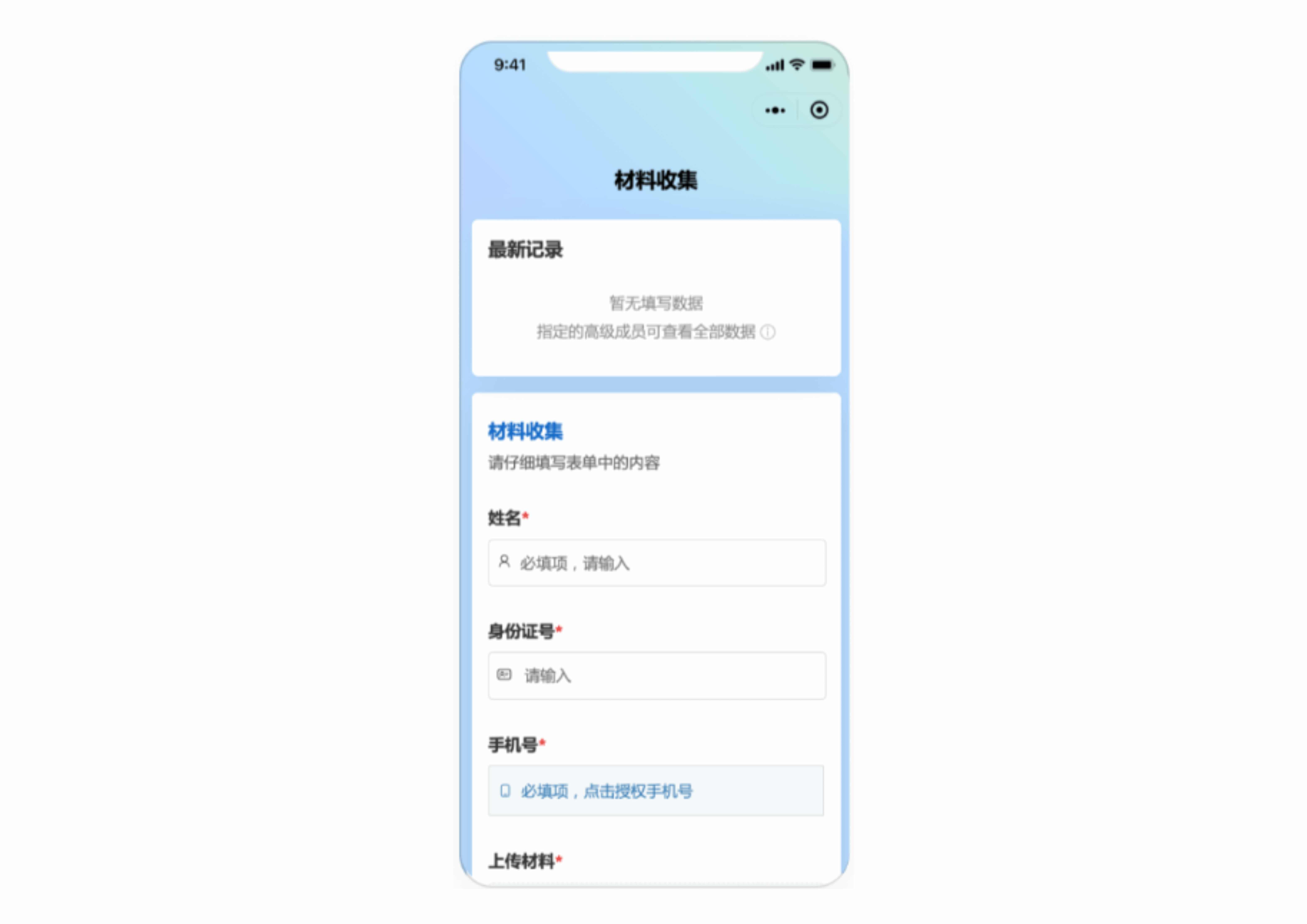
III. Practical Example: Building a New Student Registration Process from Scratch
Based on the practical experience of a medium-sized vocational school, the process can be briefly summarized in three steps:
Step 1: Information Sorting and Breakdown
Two months before the start of the school year, the school compiled a list of required information, such as:
- Basic New Student Information (Name, ID Number, Student ID, Contact Phone Number)
- Parent and Emergency Contact Information
- Accommodation Needs and Clothing Sizes
- Enrollment Document Uploads (ID Card, scanned copy of Admission Notice, etc.)
Step 2: Building a QR Code Directory Page
Using the CaoLiao QR Code platform, three forms were generated, and a summary directory page was created: Personal Information Registration Form; Accommodation and Item Declaration Form; Return to School Time and Check-in Plan Form. All new students only needed to scan one QR code to access multiple registration tasks and complete them in sequence.
Step 3: Progress Tracking and Data Export
The system backend automatically synchronized the entered data, supported Excel export, and the CaoLiao QR Code platform allowed filtering by field for a clear overview. Ultimately, the school completed the information collection task for over 800 new students in less than a week, far superior to the weeks required for manual registration in previous years. 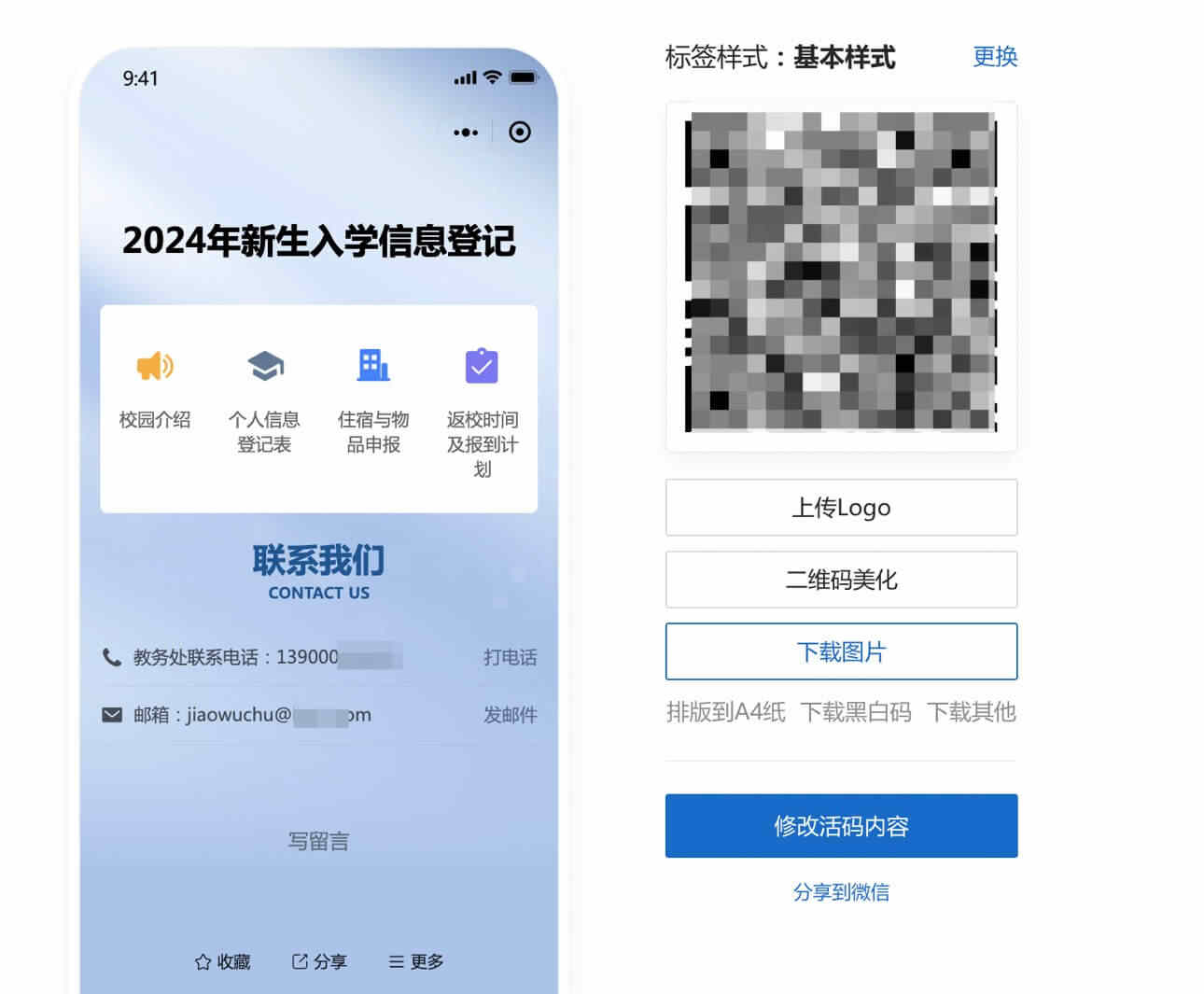
IV. Precautions and Optimization Suggestions
Although QR codes are simple to deploy, the following points are worth noting to ensure data quality and user experience:
- Pre-testing and Internal Drills: After creating the QR codes, homeroom teachers and staff should be organized to conduct filling tests to identify logical errors and user experience issues.
- Early Release with Deadline: Avoid collecting information too close to the start of school, which could affect arrangements for dormitories, military training uniforms, etc.
- Unified Entry Point to Avoid Repeated Notifications and Confusion: If there are multiple forms, it is recommended to aggregate them in a single directory QR code, clearly explaining the filling order and purpose to reduce student confusion from searching and switching across multiple channels.
Final Thoughts
On the surface, new student registration might seem like just "filling out a few forms," but in essence, it's a test of information organization and execution efficiency. The value of QR code tools lies not in flashy technology, but in adhering to three fundamental principles: "Simple Entry," "Clear Structure," and "Closed-Loop Process."
The application of tools like CaoLiao QR Code allows schools to quickly build a registration mechanism tailored to their own processes without any development. Especially under the realistic constraints of the peak enrollment period – strained manpower and numerous tasks – relying on structured, low-barrier, controllable, and manageable tools is a pragmatic choice many schools are gradually turning towards.
The goal isn't necessarily to build an overly complex system, but to use the right "tool" effectively. This is the true value of the QR code solution.