What Tools Do Travel Agencies Use to Collect Registrations and Information? Automatically Gather Data Without Developing an App
Original: https://cli.im/article/detail/2417
For travel agencies, "collecting registrations and information" is a routine task. Whether it's long-distance tours, customized tours, scenic spot collaborative activities, study camps, senior tours, or corporate team-building events... as long as organizing group participation is involved, two things are almost always necessary:
- Collecting expressions of interest and confirming lists
- Gathering participant information, such as ID cards, visa pages, health certificates, travel intention surveys, emergency contacts, etc.
In the past, this was done through WeChat groups, Excel sheets, and manual communication. But when the number of participants increases, schedules are tight, and the age range of participants varies, what seemed like a simple process often becomes lengthy, chaotic, and error-prone. Consequently, many travel agencies are considering: Is there a way to collect registrations and information more easily without developing an app or deploying a separate system?
This article combines industry practices, starting from the goals and usage needs of information collection, to explore several common tool selection options. Using the QR code solution as an example, it explains the practical operational logic. We hope to provide actionable, efficient references for frontline staff engaged in travel reception, channel agency, and product operations.
1. What Exactly is Being "Collected" in Travel Registration Information?
On the surface, it seems like just collecting a "yes" or "no" about participation. But in practice, the registration system handles the crucial functions of preliminary communication and information confirmation. Commonly collected content includes:
- Basic identity information: Name, phone number, ID number, date of birth
- Emergency contact information: Contact's name, phone number, relationship
- Travel needs or preferences: Pick-up location, accommodation choice, room sharing preference, special dietary requirements
- Document or photo uploads: ID card, visa page, signed agreement
- Fee status and payment proof: Whether payment has been made, payment screenshot
- Post-registration grouping/transport arrangement information: Batch number, vehicle choice, meeting point confirmation, etc.
Different types of tours have different requirements for information collection methods. For example:
- Parent-child study tours: Often require collecting information for both the child and parent; form design needs to allow for paired entry.
- Senior tours: Need to focus on health status, medication instructions, and whether accompanied by family members.
- Overseas long-distance tours: Many materials; requirements for document upload formats must be clear, requiring strong data management capabilities.
Therefore, the idea of "one form fits all" is largely unrealistic. A more practical approach is to build flexibly configurable collection channels with capabilities for information verification and upload guidance – this is key for travel agencies to efficiently collect registration information.
2. Tool Comparison: What's More Suitable for Collecting Information?
Currently, the most commonly used registration and information collection tools among small and medium-sized travel agencies can be roughly categorized as follows:
1. WeChat Groups + Excel + Manual Organization
This is the most traditional method, still widely used by many travel agencies. Notifications are sent via WeChat groups, participants send information privately to the tour leader, and operational staff manually enter it into Excel or print paper records.
- Advantages: Zero barrier to entry, flexible handling of complex communication.
- Disadvantages: Prone to omissions, format inconsistencies, extremely time-consuming manual organization, highly error-prone especially when handling multiple tour groups simultaneously.
- Suitable Scenarios: Small numbers of participants, simple requirements, e.g., friend groups, small team-building events. Not suitable for bulk registrations, remote agency channels, or groups requiring high data completeness.
2. Mini Programs or Third-party Registration Systems
Some travel agencies use ticketing systems or third-party mini program tools (e.g., Wei Lv Tong, Lv Hua Suan, etc.) to collect registrations. These tools can provide registration forms, order payments, information uploads, etc.
- Advantages: Feature-rich, integrated processes.
- Disadvantages: Reliant on platform binding, difficult to promote externally to agents; higher costs if custom development is involved; limited flexibility.
- Suitable Scenarios: Suitable for medium-sized travel organizations with some technical resources or an existing private platform ecosystem. Less adaptable for small local agencies, temporary reception needs, or individual customer acquisition scenarios.
3. QR Code Information Collection Forms (e.g., CaoLiao QR Code)
In recent years, QR codes have become a lightweight tool for travel agencies to collect information. Using platforms like CaoLiao QR Code, you can generate a QR code leading to a form page. Tourists scan the code to fill in information online and upload document photos. The backend allows real-time data viewing and export to spreadsheet files.
- Advantages:
- Quick Setup: Provides ready-made templates, no development needed; creating a form takes just 10 minutes.
- Unified Channel: A single QR code can be distributed on posters, WeChat, Moments, landing pages, etc.
- Flexible Forms: Customizable as needed, supports photo uploads, option selection, grouping logic.
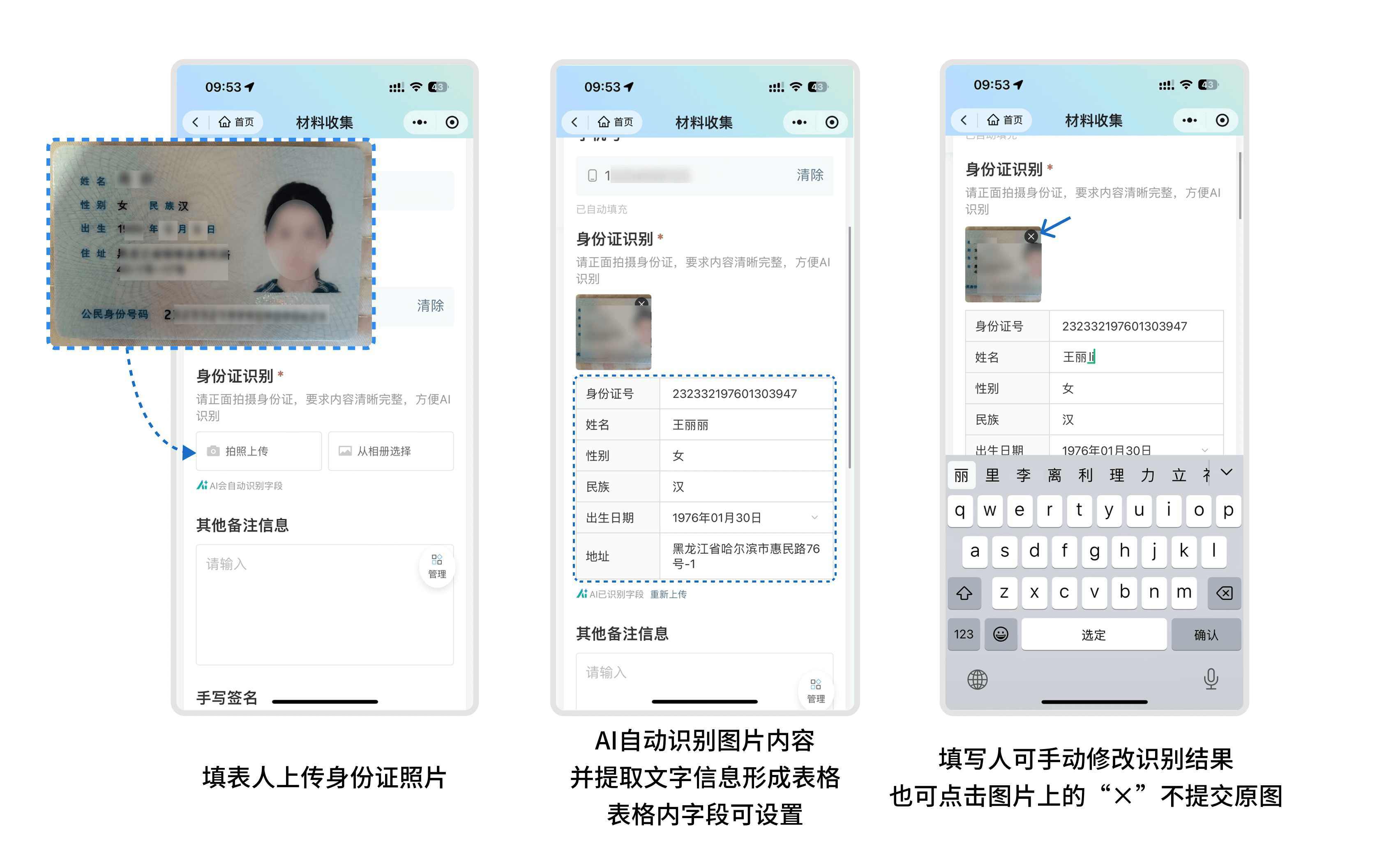
- Efficient Collection: CaoLiao offers OCR functionality; the system can automatically recognize and fill in information from uploaded photos.
- Centralized Data: Unified backend management, real-time updates, exportable.
- Disadvantages: Only suitable for information collection scenarios; cannot handle order payments, contract signing, etc.
- Suitable Scenarios: Ideal for the "mid-early" stages for most travel agencies, such as collecting lists of interested parties, verifying information, organizing guest lists. Especially suitable for scenarios where system deployment is not desired, but there are many agents or temporary activities.
3. How Does the QR Code-Based Collection Scheme Work?
Concretely, using CaoLiao QR Code as an example, setting up a "Registration Information Collection Page" typically involves just three steps:
Step 1: Design the Information Structure
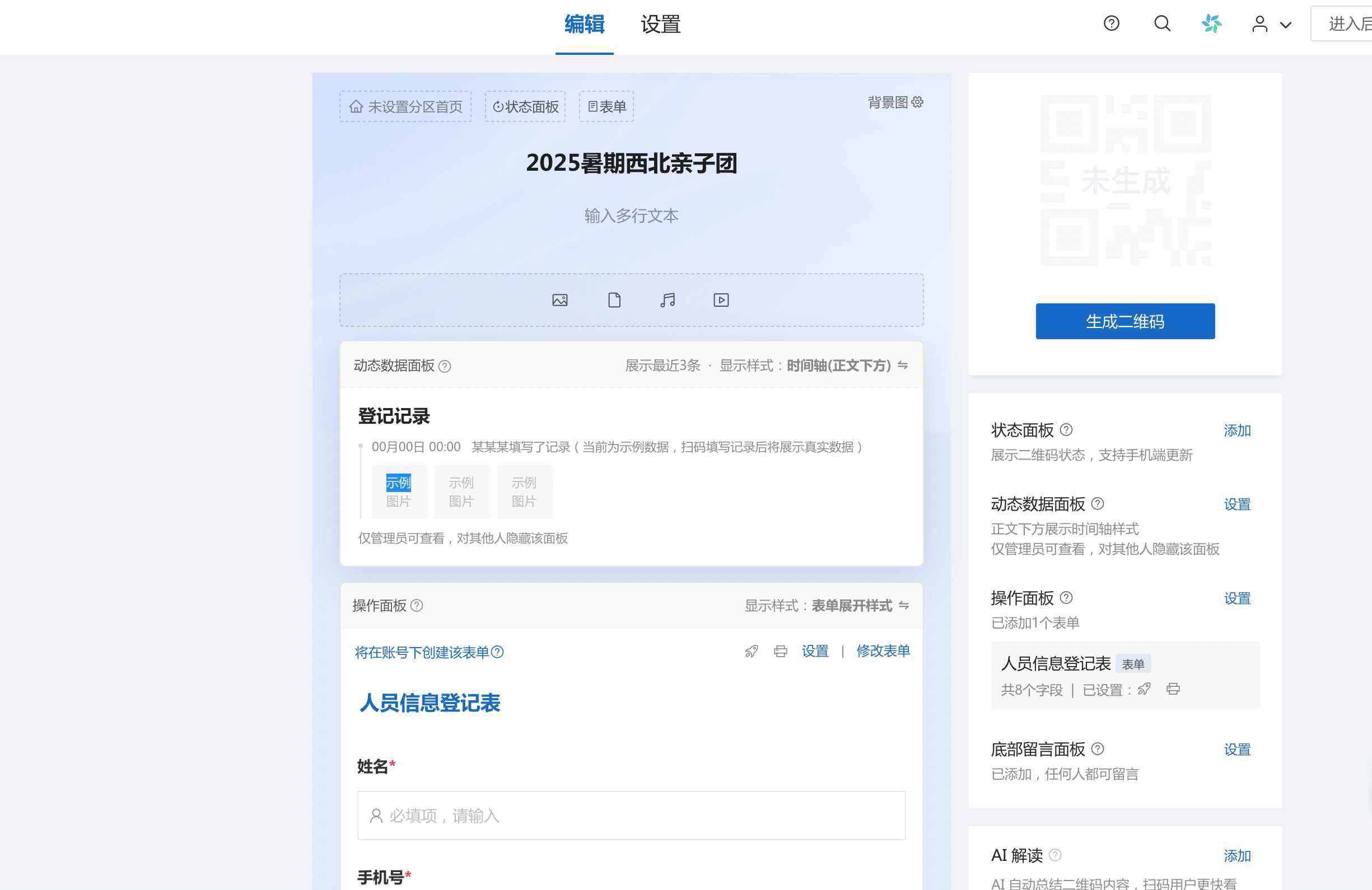
Create a form. You can use a template or start from a blank custom form, selecting the field types you need. For example:
- Input fields: Name, phone, ID number
- Dropdown single/multiple selection: Accommodation type, pick-up location, room sharing preference
- Image upload: Front/back of ID card, payment screenshot
- Time selection: Departure time, preferred meeting time
- Text description: Remarks, allergy history, etc.
Step 2: Generate the QR Code
After creation, the system automatically generates a QR code. This can be printed on posters, sent to WeChat groups, Moments, Official Accounts, or embedded in other registration pages.
Step 3: Collect, Export, and Manage Data
The backend allows real-time viewing of each submission. Data can be exported to Excel for subsequent itinerary planning, list coordination, contracting, etc.
4. What Key Problems Does It Solve?
The core reason travel agencies choose QR codes for information collection isn't about "following trends" but addressing three practical pain points:
- Standardized Information Entry Previously using Excel or private WeChat chats led to inconsistent formats, requiring manual sorting afterward. QR code forms predefine field structures, reducing manual organization and improving data integration efficiency.
- Unified Cross-Channel Entry Point A single QR code works across multiple channels (WeChat groups, Moments, promotional materials, agents), avoiding repetitive questions like "Which group did you sign up in? Which registration channel? Which batch?"
- Improved Customer Filling Experience Compared to complex mini-programs or login systems, QR codes allow filling immediately upon scanning. Combined with image uploads and AI recognition, the process is intuitive and reduces operational burden, especially for non-frequent internet users like seniors or parents.
5. Usage Suggestions and Considerations
Although the QR code solution is lightweight, to implement it efficiently, pay attention to the following:
- Plan Field Logic in Advance Too many fields significantly degrade the user experience; too few require collecting additional information later. Design the filling path in advance to avoid redundancy or missing critical info.
- Naming and Grouping for Easy Subsequent Filtering and Archiving As the number of tours, channels, and registration batches increases, information can easily mix and become hard to trace. When creating the QR code or form, use clear naming conventions (e.g., "2025 Summer Northwest Parent-Child Tour - Batch 1"). This allows quick location of data for specific tours or channels in the backend, preventing omissions and duplicate processing.
6. Conclusion
For information collection in the travel industry, the value lies not in how advanced the tool is, but in whether it fits the scenario, facilitates frontline execution, and ensures a closed data loop. The QR code form approach is essentially a "low-barrier, high-compatibility" solution path.
It doesn't aim to replace order systems or handle payment processes, but focuses on the area where travel agencies are most prone to chaos – information collection. From gathering expressions of interest and collecting materials, to consolidating agent channel information, and replacing paper questionnaires, QR code tools have become part of the daily routine in many travel organizations.
No development required, no platform dependency, no technical barriers, flexible configuration, quick deployment, and suitable for most ordinary operational staff to use directly – the value of such tools lies precisely in "fulfilling high-frequency, essential needs at low cost."
For small and medium-sized travel organizations looking to gradually digitize their management processes, this might be the most worthwhile first step to try.