How to Make Portable Dry Powder Fire Extinguisher Inspections Executable, Traceable, and Manageable?
Original: https://cli.im/article/detail/2419
In various factory areas, commercial buildings, and public spaces, portable dry powder fire extinguishers are among the most common firefighting equipment. They are compact, easy to use, and crucial tools for handling initial fires. However, in daily management, extinguisher inspections and maintenance are often treated as routine tasks. Many units "check the box" and "sign off" on time each month, yet the extinguishers fail to function effectively in real emergencies. Where does the problem lie?
Superficially, it seems like poor execution, but more often than not, the root cause is the lack of a genuinely effective inspection mechanism. This article will start from the actual workflow, analyze common issues in fire extinguisher inspections, and explore how to use digital tools (such as QR code systems) to build a more efficient management model.
Common Issues in Fire Extinguisher Inspections
Traditional inspection processes mostly rely on paper forms. Management personnel distribute inspection sheets uniformly, inspection staff fill them out on-site, and then administrators collect and archive them. This approach is straightforward but comes with significant drawbacks.
- Information Gaps: Form content is typically very limited, including only inspection times and signatures, lacking detailed descriptions of abnormalities, equipment status, or replacement records. When problems arise, it's difficult to trace the specific situation of a particular extinguisher.
- Difficulty Standardizing Execution Processes: Fire extinguishers are often scattered and numerous, making it easy for inspectors to miss some. Furthermore, management lacks real-time supervision methods. Even with detailed inspection standards, the lack of traceable execution and recording prevents the process from being reliably implemented.
- Discontinuous Problem Handling: For example, if low pressure is found during an inspection, the record might be left on a paper form, neither triggering a subsequent repair process nor being fed back into the equipment status management system. The result is that even when problems are identified during inspection, they aren't resolved, potentially creating a false impression that "the inspection is complete."
What Characteristics Should an Effective Inspection Mechanism Have?
To genuinely improve the quality of fire extinguisher inspections, three core issues need to be addressed systematically: execution capability, traceability, and management efficiency.
- Execution Capability: A good inspection process must first be simple enough for frontline staff to be willing and able to execute it. Inspection items should be clear, and process operations should be intuitive, ideally requiring no extra training. The system should automatically record inspection times and personnel information and include basic mechanisms to prevent missed inspections.
- Traceability: Records must be bound to specific equipment. Each extinguisher should have a unique identifier, and its historical inspection and maintenance records should be saved and viewable in a timeline. This traceability not only facilitates problem analysis but also helps clarify responsibilities when necessary.
- Management Efficiency: For managers, having all data presented centrally and automatically summarized is key to improving work efficiency. The ability to quickly see how many devices are pending inspection, if there are unhandled abnormalities, and which extinguishers are nearing expiration – this information needs to be clear at a glance.
Achieving these goals is difficult relying solely on paper records and manual processes. This is precisely why QR code solutions are increasingly being adopted by more organizations.
Using QR Codes to Make Fire Extinguisher Inspections Controllable
Attaching a QR code to each fire extinguisher as its "identity tag" is a widely adopted practice. Staff can simply scan the code with their mobile phones to access the inspection entry for the corresponding device, fill out inspection information, report abnormalities, and view historical records.
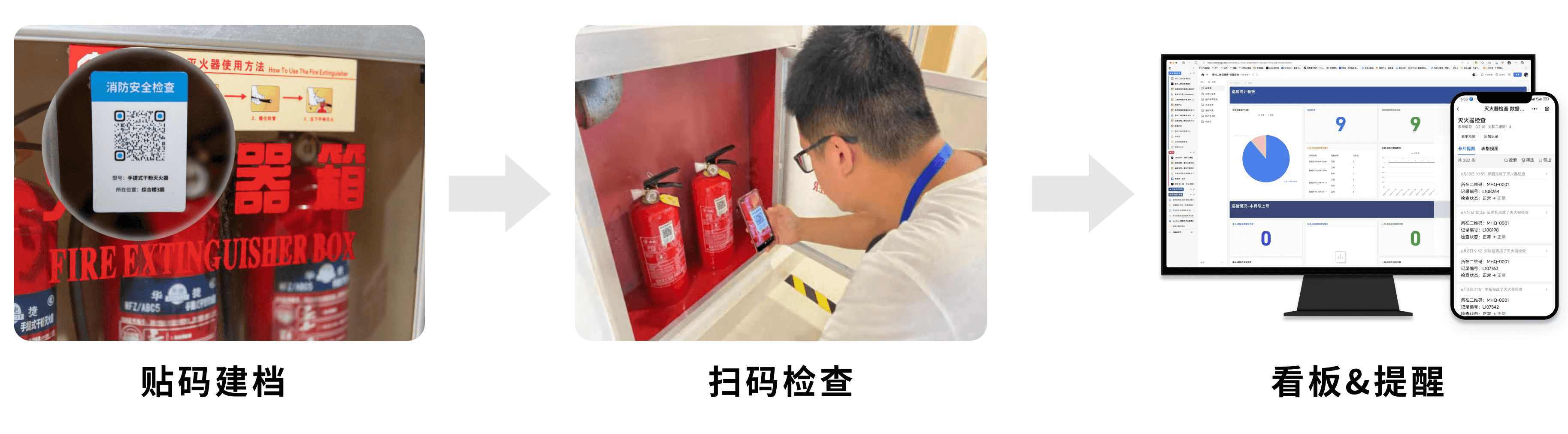
The QR code serves not just a locational function; more importantly, it creates an independent data account for each extinguisher. By embedding standardized inspection forms within the scan page, the spot-check process can be standardized. For example, checks for validity period, normal pressure gauge reading, intact lead seal, presence of damage, and stability of the extinguisher bracket can all be handled through pre-set fields for selection and filling, accompanied by photo documentation.
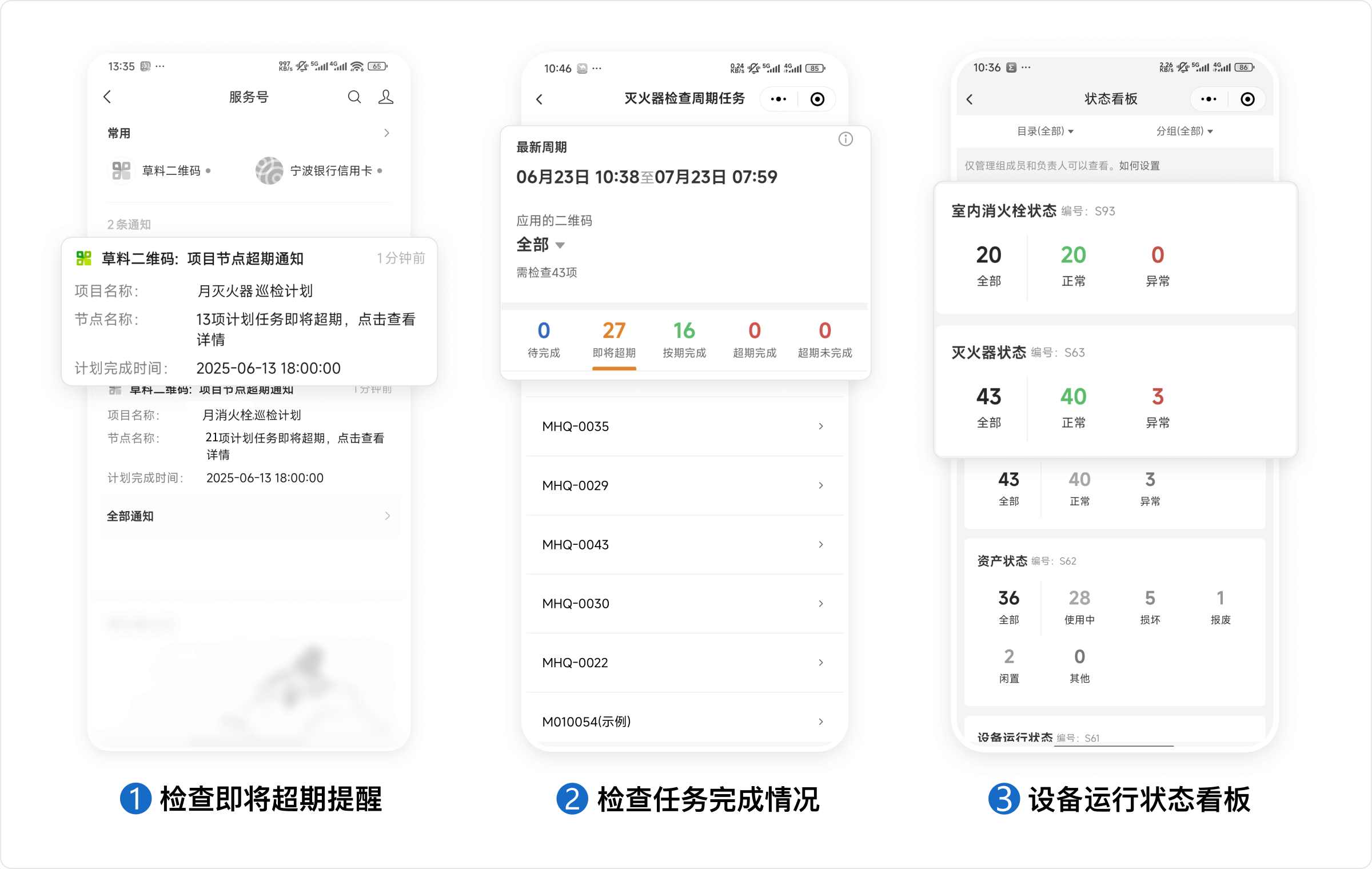
Management personnel can receive task reminders on their phones and also view equipment operational status on their workbench.
The Practical Capabilities and Advantages of CaoLiao QR Codes
Among various QR code tools, CaoLiao QR Code is adopted by many property management units, corporate safety departments, and hospital logistics as a frontline execution tool for fire extinguisher inspections, thanks to its flexible deployment, low learning curve, and centralized management.
- Generation of Device-Specific QR Code Pages: CaoLiao provides functionality to generate device-specific QR code pages. It supports batch importing extinguisher numbers, models, installation locations, etc., via Excel, batch generating QR codes, and directly exporting them for printing and posting. Scanning the code leads to the device details page where custom inspection forms can be filled out, supporting photo uploads, abnormality tagging, etc.
- AI Smart Form Filling: CaoLiao also features "AI Smart Form Filling" capability. After scanning and uploading a photo, it can automatically extract key information from the image and populate the form fields. For instance, uploading a photo of an extinguisher allows the system to automatically identify information like pressure and safety pin status. This process typically takes only two or three seconds, significantly reducing manual input and avoiding recording errors caused by mistaken entries.
- Data Management and Export: All data is stored in the cloud in real-time. Administrators can export data to Excel at any time, forming a complete data loop suitable for reporting, auditing, and risk investigation.
It's important to note that CaoLiao QR Code is not equivalent to a full-fledged fire safety management system. It functions more like a lightweight front-end execution tool, helping managers implement processes and accumulate records. For organizations that haven't yet established a fire safety information platform, or for small and medium-sized venues that only require basic inspection tasks, it is a suitable starting solution.

Easily Overlooked Issues During Implementation
When implementing a QR code solution, certain aspects still require attention.
- Fire Extinguisher Inventory Cleanup and Numbering: It's advisable to clean up and uniformly number the fire extinguisher inventory before implementation to avoid misaligned scan information later, which could impact management efficiency.
- QR Code Label Material: Fire extinguishers are often located in high-temperature, humid, or high-friction areas. It is recommended to use high-strength, waterproof labels that adhere firmly and scan smoothly.
- Operator Usage Habits: Although scanning the code itself isn't complicated, initial unified instructions are still necessary, especially clarifying how to report abnormalities, how to fill out descriptions, whether photos are required, and which fields are mandatory.
Conclusion: Moving from "Checking Boxes" to a Responsibility Loop
Fire extinguisher inspections might seem like a minor task, but they relate to the last line of defense for safety. Past paper-based processes might leave "traces" of work but fail to ensure "results"; inspection records might be plentiful but cannot truly form a risk control mechanism.
Leveraging QR code tools, especially flexible and adaptable platforms like CaoLiao QR Code, can help organizations start from daily execution, making inspection work substantive, detailed, and traceable. This doesn't require a large investment nor high barriers to entry; it's a practical path that allows for quick piloting and gradual scaling.
The true value of management lies in creating a closed-loop inspection process, clear responsibilities, and verifiable issues. If you are promoting related work, QR codes might be a worthwhile starting point.