How to Ensure Compliant Management of Personal Protective Equipment? National Standards Provide Clear Requirements
Original: https://cli.im/article/detail/2431
As enterprises increasingly prioritize workplace safety management, the provision and management of Personal Protective Equipment (PPE) have evolved beyond simply "issuing items." They have become critical aspects of regulatory inspections, accident investigations, and liability determinations. GB 39800-2020 "Specifications for the Provision of Personal Protective Equipment" and AQ 6111-2023 "Safety Management Specifications for Personal Protective Equipment" are two core standards that enterprises must adhere to when implementing PPE management systems. These standards specify detailed requirements for the entire lifecycle management of PPE, including selection, approval, distribution, use, recovery, and disposal.
This article systematically outlines the key requirements for PPE provision and management based on the original standards. It also combines practical applications of digital tools to provide enterprises with an actionable compliance management solution.
Interpretation of National Standard Requirements
GB 39800-2020 explicitly states: "Appropriate personal protective equipment should be selected based on the protected body parts, protective functions, scope of application, etc. There must be corresponding sound management systems, establish and improve relevant archives, and ensure standardization in processes such as procurement, acceptance, storage, selection, distribution, use, disposal, and training."
This standard provides systematic guidance for the provision of PPE from a technical perspective, requiring enterprises to have basis and procedures for risk assessment, job analysis, and selection of protective equipment. AQ 6111-2023 "Safety Management Specifications for Personal Protective Equipment" further supplements from a management system perspective, stating: "Personal protective equipment should be distributed according to the job-specific PPE provision list and based on demand," "Distribution should be carried out by warehouse or PPE management personnel, and must record key information such as distribution time, recipient, equipment name, model/specification, quantity, etc.," "All distribution records must be reviewed and signed by the on-site supervisor or safety management personnel."
This standard emphasizes that the entire process of PPE management, from distribution to return and disposal, should form a closed-loop record. Approval processes should be clear and traceable, and data should be archived for future reference.
Why Emphasize PPE Management?
According to annual reports from the Ministry of Emergency Management, the proportion of injury accidents caused by failure to wear or incorrect wearing of PPE remains persistently high. In practice, a construction worker not wearing a safety helmet or an operator not wearing chemical protective clothing can lead to severe consequences in an instant.
After an accident occurs, regulatory authorities not only check whether the enterprise has provided PPE but also investigate "whether it was distributed," "who approved it," and "whether there are signed records." In the absence of records, the enterprise is presumed to bear management responsibility. This is why an increasing number of enterprises are beginning to emphasize the digitalization of the "recording process."
Furthermore, in scenarios such as occupational disease prevention and labor arbitration, PPE receipt records serve as crucial evidence. In many cases, enterprises have been judged to have management deficiencies and assumed unnecessary legal liabilities and public opinion pressure due to their inability to provide compliant and complete PPE distribution records. The root cause often lies not in "whether PPE was provided" but in "whether it can be proven that it was provided and managed as required."
In reality, this issue is widespread: paper-based registrations with incomplete information or illegible handwriting, or the use of Excel without approval controls, often lead to missing records or data inaccuracies. Once an accident occurs, situations where "no record of the person exists" are not uncommon, increasing the risk of accountability for management.
How to Achieve Compliant Management at Low Cost?
To address the above issues, many enterprises have begun using lightweight digital tools to optimize management processes. Compared to custom systems, QR code solutions offer advantages such as low cost, flexible configuration, and rapid deployment, making them the preferred digital choice for many small and medium-sized enterprises. Below, using the [PPE Receipt Registration] template provided by the CaoLiao QR Code platform as an example, we detail how enterprises can quickly set up a PPE receipt registration system that complies with GB 39800 and AQ 6113 requirements:
1. Create QR Code
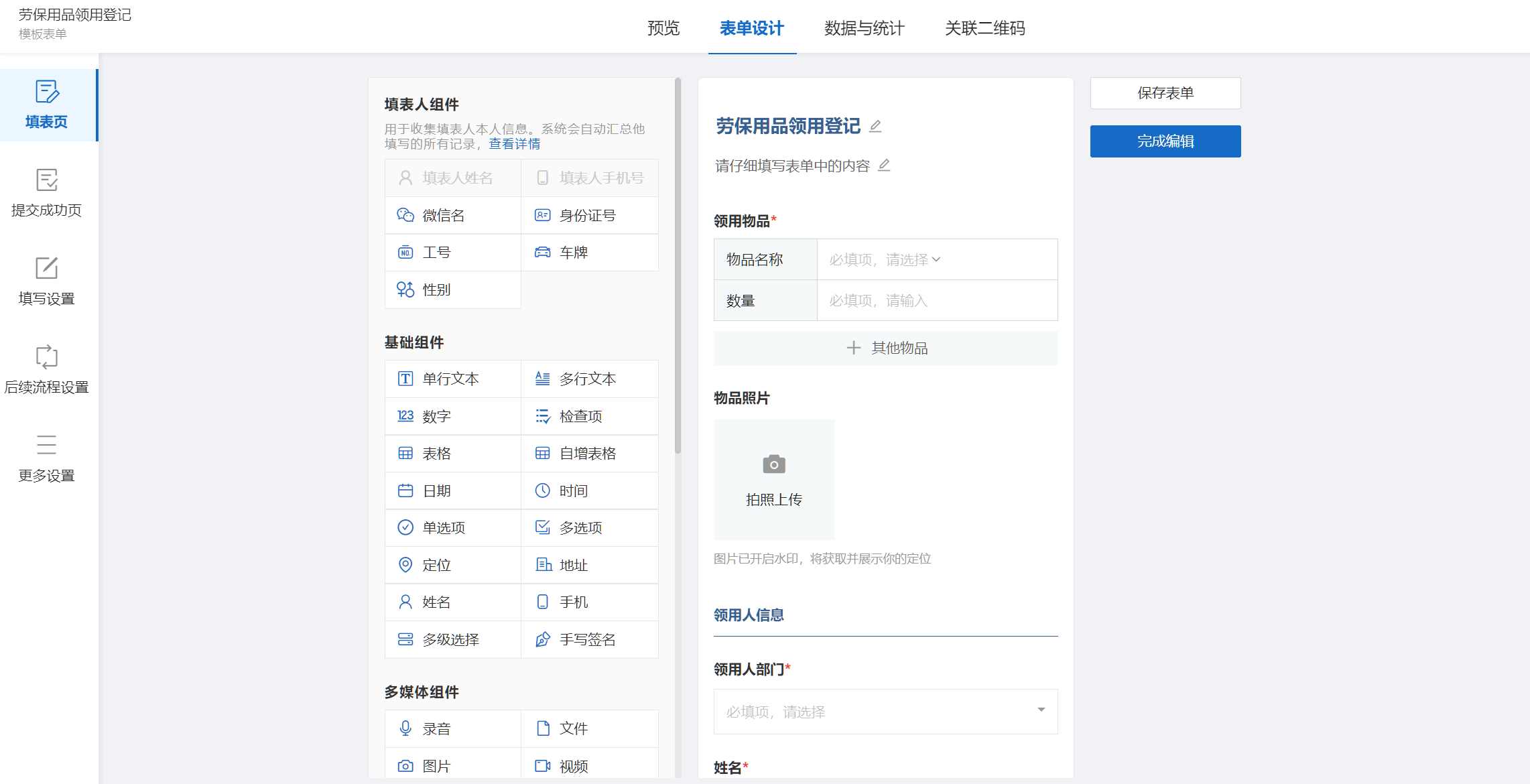
On a computer, go to the CaoLiao QR Code official website, enter the template library, and select the [PPE Receipt Registration] template. Enterprises can modify the template content according to their actual management requirements. For example, pre-set the names of PPE items in the receipt form (allowing recipients to select from a dropdown during registration without manual typing, ensuring standardized statistics), add fields for recipient's name, department, handwritten signature, etc., and choose whether to set up an approval process as needed.
2. Post the QR Code
Post the QR code in the PPE warehouse, workshop entrance, or distribution points to facilitate employee registration via scanning.

3. Employees Scan to Fill Records
Employees or team leaders use WeChat to scan the code, fill in the received items and quantities, take photos to document the physical receipt, and enter their department, name, and authorized mobile number. The photos taken automatically include timestamps, location watermarks, etc., ensuring the receipt records are authentic and traceable.
4. Automatic Data Archiving and Export
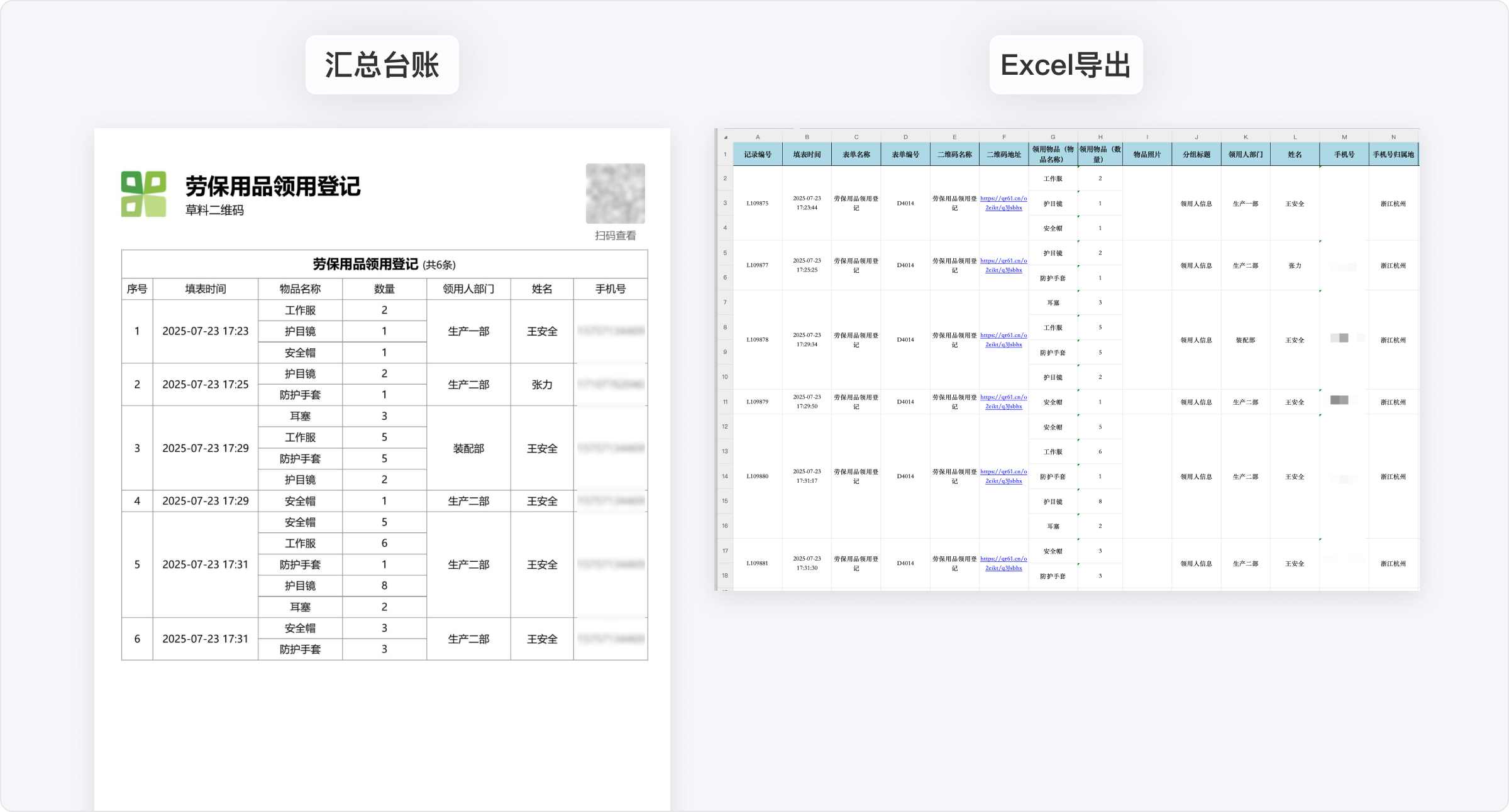
All receipt records are automatically synchronized to the system backend. They can be filtered and viewed on both mobile and computer interfaces based on criteria such as time, personnel, and items. Records can be exported to Excel spreadsheets for daily inspections and annual audits. API integration is also supported, automatically aggregating data to generate visual reports and improving management efficiency.
The Management Value of Standardized Records
Some might think that distribution records are just procedural and can be checked after problems arise. However, the reality is that accidents, regulatory inspections, and audits won't wait for you to retroactively create records. Standardized and complete PPE records are not only a manifestation of compliance but also evidence of the enterprise's responsibility for employee safety.
Especially in today's environment of increasing inspection frequency, the presence of records, their traceability, and authenticity directly determine whether an enterprise can pass on-site verifications smoothly. Under pressure, relying on human memory is inferior to relying on systems; relying on paper records is inferior to relying on QR code scanning.
The emergence of tools like CaoLiao QR Code provides new possibilities for "low-cost digitalization." This approach is particularly suitable for small and medium-sized enterprises. It doesn't require system development, doesn't depend on IT resources, managers can use it quickly without training, and it doesn't need complex deployment. With just a mobile phone and internet access, the entire process from distribution to recovery can be recorded. Compared to traditional methods, it not only saves time but also significantly improves data integrity and compliance.
In an era where safety compliance and management efficiency are increasingly important, enterprises should emphasize starting from every task, every employee, and every distribution record—transforming standards into management practices and implementing process closed-loops down to traceable and verifiable details.