Using QR Codes to Identify Safety Hazards Around You, Aligned with Safety Month Theme
Original: https://cli.im/article/detail/2389
Every June marks a critical period nationwide for enhancing safety awareness. This year is already the 24th "National Work Safety Month." The theme for this year is: "Everyone Talks Safety, Everyone Can Respond – Identify Safety Hazards Around You." While this phrase might sound familiar, if you have ever been responsible for safety inspections on the ground, you'll understand it's not that simple.

The organization I work for is an ordinary manufacturing company. We don't have a huge number of employees, but the workshop environment is relatively complex, involving high-temperature equipment, flammable materials, and numerous hot work operations. Every year when "Safety Month" arrives, like most companies, we put up posters, arrange training sessions, and hold a safety knowledge contest. But honestly, apart from the buzz on the day itself, most people don't feel deeply involved.
That changed last year when we experimented with a new approach: posting QR codes next to workshop equipment, allowing scans to fill out inspection records. This small experiment actually helped us genuinely implement the "hazard identification" work in our subsequent daily management.
What's Wrong with Traditional Paper-Based Inspection Records?
Previously, we used paper forms for hazard identification and inspection. The format wasn't the issue, and records were filled out step-by-step. But over time, many practical problems emerged:
- Forms were filled out inconsistently, with messy handwriting.
- Photos sent to WeChat groups couldn't be matched with the specific forms.
- Tracing a particular hazard rectification record meant sifting through piles of paper.
- Most awkwardly, often the "inspections" became mere formalities, lacking necessary feedback and closure.
On the surface, these seem like process issues, but they actually reflect deeper problems: high management costs, low employee engagement, and a weak safety culture. We realized that for "hazard identification" to be truly sustainable, it couldn't rely solely on procedural enforcement. It needed a tool that was more practical and easier to use.
What's the Experience Like Using QR Codes for Hazard Identification?
We piloted this using CaoLiao QR Codes. Initially, we posted QR codes on firefighting equipment like fire extinguishers and hydrants, attempting to replace paper records with a digital method. The results were surprisingly positive.
- Simple Operation, Employees Are Willing to Use It: Workshop workers, security guards on duty – anyone who can use WeChat to scan a code can complete inspections, upload photos, and report issues. The average operation time per person is under two minutes.
- Automatic Data Archiving, No More Worrying About 'Lost Forms': Records show which point was checked, when, by whom, along with site photos and notes. No more manual filing.
- Issues Are Seen Immediately: Once, a night shift supervisor scanned a code and reported a loose distribution box door; the equipment manager arranged for repair the next morning. Compared to the old way of "writing it on a form where no one sees it," this method is much more timely.

Later, we also posted QR codes in employee dormitories and the canteen gas room, mainly for employee self-inspections. "Minor issues" like messy wiring, cleanliness, or expired fire extinguishers could be identified earlier.
The Scenario Isn't Complex, and the Tool Isn't Expensive
Many people hear "digital management" and assume they need new systems or developers. Actually, we just modified the content using templates from CaoLiao QR Codes, configured it on the computer, and printed and posted the codes. Checking data in the backend isn't difficult either; I'm nearly 50 and only really use Word and Excel, yet I managed it fine.
You can create QR codes for free, and CaoLiao QR Codes doesn't impose limits on the number of codes or usage volume. We started with the free version, adding QR codes to over 100 pieces of equipment and firefighting facilities in the factory. When reporting data to management proved highly effective, we directly purchased the paid version for less than 3,000 RMB – a very affordable price for SMEs like ours.
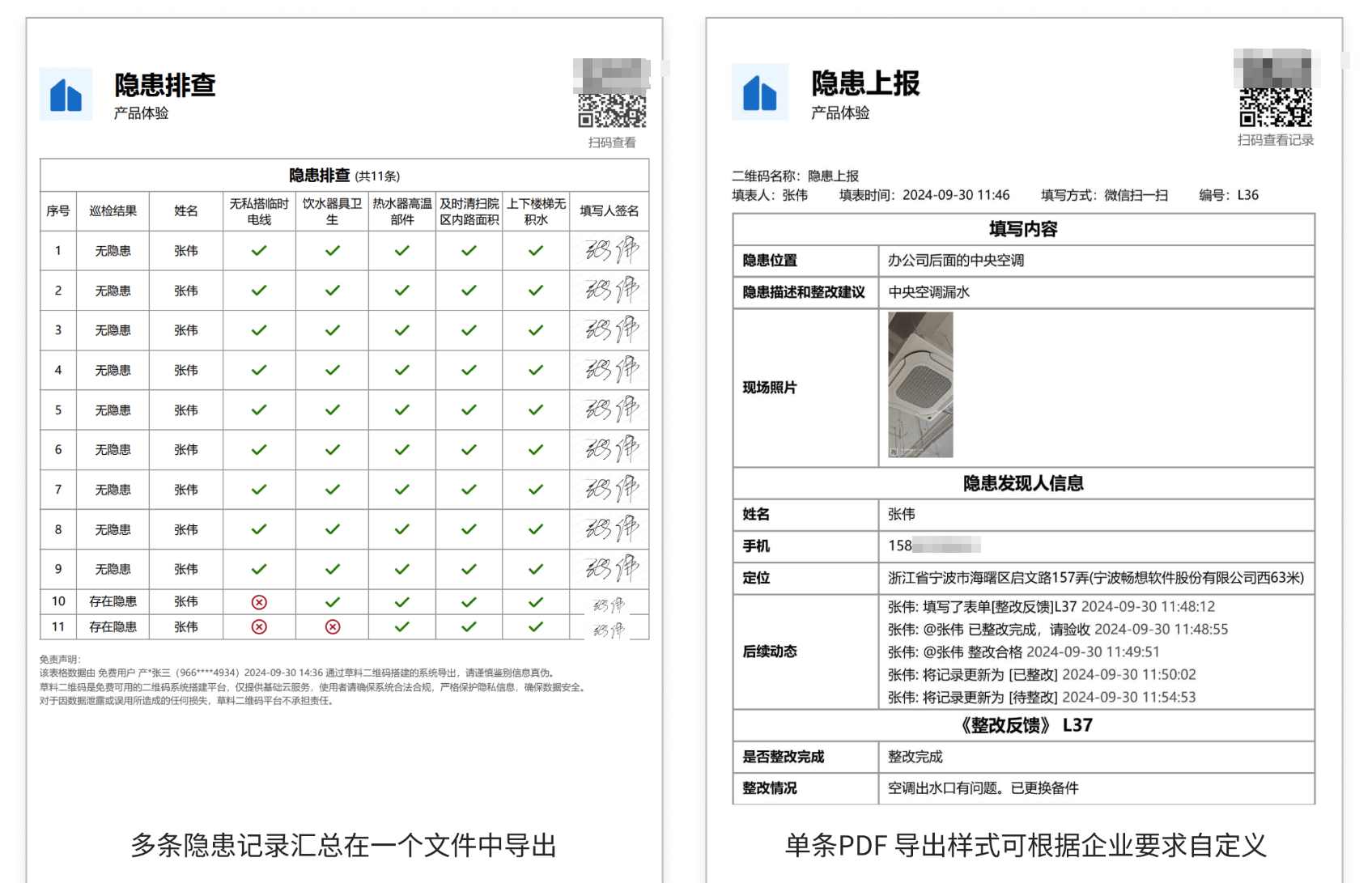
We also plan to use QR codes during Safety Month for a "Snap & Report Hazards" activity. Employees scan a code to report hazards, the safety department verifies them, and rewards are given upon confirmation to boost participation. If this activity is well-received, we'll continue it.
How We Conduct Hazard Identification – For Your Reference
1. Organize Inspection Points
List key areas in the factory – like firefighting equipment, electrical boxes, boiler rooms, gas rooms – in an Excel spreadsheet, including the point name and number.
2. Generate QR Codes in Bulk
Go to the CaoLiao QR Code website, select the "Hazard Reporting" template from the template library, and slightly modify the inspection items based on your actual requirements (e.g., hazard description, site photos/videos). After modifications, import the points Excel file. The system will generate QR codes for all points at once.

3. On-site Deployment, Pasting, and Trial Use
CaoLiao offers many label styles. Choose a suitable one, download, print, and paste it on the points. Then organize a trial. We had two groups of employees use it for two weeks first. Their feedback was: "Much easier than filling out paper forms." We then made adjustments based on their suggestions.
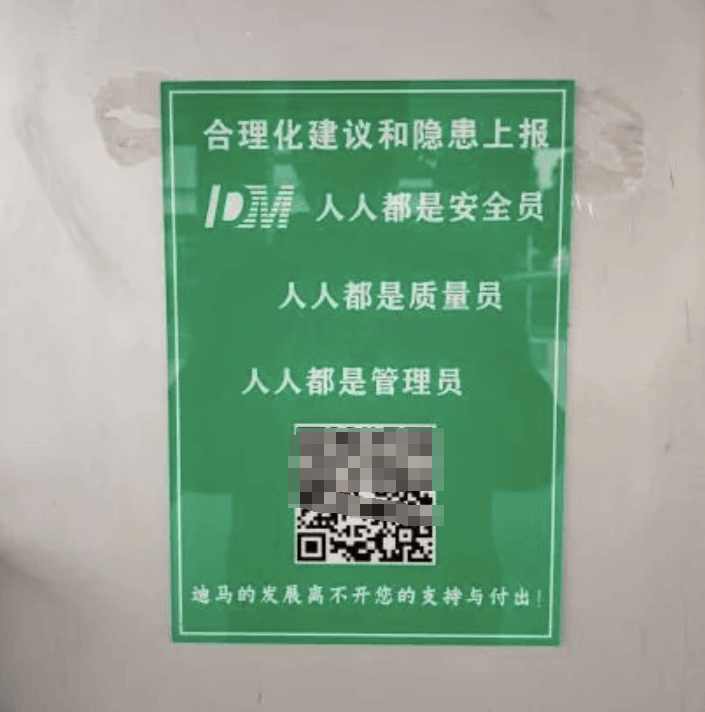
4. Promote and Scale Usage
Once the trial was successful, we rolled it out formally. Because the operation is very simple, we explained the new process during morning meetings – hardly any employee found it difficult to use. After running for a while, we expanded it to workshop supervisors, logistics staff, dormitory managers, etc., ultimately achieving "whoever is responsible, scans the code," clarifying responsibilities.
"Work Safety Month" shouldn't be just a passing trend. It should be a starting point for improving our management practices. QR codes aren't a magic bullet, but they have genuinely made our hazard identification work clearer, more practical, and closer to the goal of "Everyone Talks Safety." Compared to system development costs often reaching tens of thousands, this "lightweight yet effective" approach is more suitable for the current realities of most organizations. If your organization is also preparing for "Safety Month" activities, consider a similar approach. It doesn't require high costs or a professional development team. Starting with just a single QR code can turn "hazard identification" from a task into a habit.