Information-Based Approaches for Fire Product Quality and Safety Improvement
Original: https://cli.im/article/detail/2443
1. Policy Context: Pressures and Challenges of Full-Chain Supervision
On July 30, 2025, the National Fire and Rescue Administration, the Ministry of Public Security, and the State Administration for Market Regulation jointly issued a work plan, launching a six-month nationwide campaign to improve the quality and safety of fire protection products. This initiative explicitly requires coverage of the entire chain, including production, distribution, usage, and certification inspection, focusing on over twenty types of products such as portable fire extinguishers, fire escape respirators, sprinkler heads, and fire doors.
The plan outlines six key directions and sixteen specific tasks, ranging from reinforcing quality responsibilities and standardizing certification testing to cracking down on illegal activities and innovating supervision methods. This is both a response to safety risks associated with fire protection products and a signal pushing for an upgrade in industry governance methods.
For enterprises, this means products must not only be compliant upon leaving the factory but also undergo continuous inspection and verifiable traceability throughout the distribution and usage stages. For regulatory authorities, new methods are needed to support a supervision logic that is "full-process, verifiable, and accountable."
2. Practical Challenges: Information Silos and Insufficient Inspection Trails
In practical management, the industry has long faced the following issues:
- Difficulty in Product Traceability Although each batch of products has serial numbers and certificates of compliance, information at the distribution and usage stages is often scattered across paper records or Excel spreadsheets, making quick correlation difficult. During spot checks or incident investigations, the information chain is prone to breakage.
- Inspections Becoming Perfunctory Daily inspections of fire protection equipment are frequent, but recording methods mostly rely on paper forms or scattered photos, creating risks of falsification or omission. Regulatory authorities struggle to verify their authenticity promptly.
- Delayed Data Feedback Policies require that spot-check results be quickly uploaded and available in real-time; however, traditional recording methods hinder immediate synchronization, leading to disconnects in the rectification and re-inspection processes.
These issues are precisely the context behind the new regulations' emphasis on "innovating supervision methods."
3. Tool Requirements: An Information Entry Point Attached to Physical Objects
Under policy pressure, both enterprises and regulators need not just systems but practical operational tools. The core features should include:
- A physical label attached to the product, corresponding one-to-one with the equipment.
- Immediate information access via scanning, directly displaying product origin, test reports, service life, inspection records, etc.
- Support for data trails, where the inspection process includes photos, location data, and timestamps to prevent falsification.
- Centralized backend management for easy report generation, aggregated analysis, and hazard identification.
QR codes naturally meet these needs. They can connect physical products with digital information, providing a common entry point for production, usage, and supervision stages.
4. Industry Practice: Implementing QR Codes in Fire Inspections
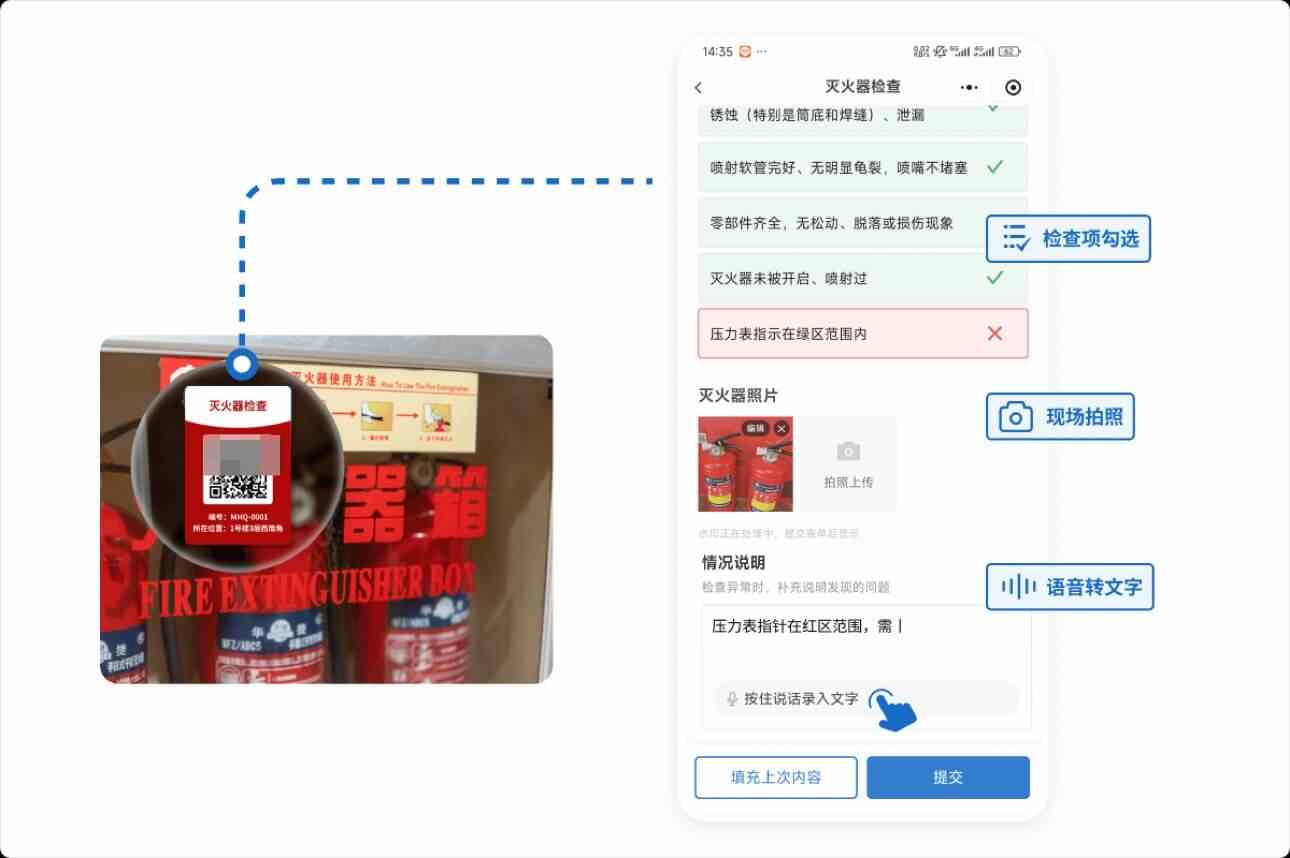
In some organizations, this approach has already been applied to fire safety management. Taking fire extinguisher management as an example, we observe that some units utilize CaoLiao QR codes for inspections:
- Dedicated QR Code per Device Each fire extinguisher is assigned a unique QR code. Scanning it reveals basic product information, production batch details, and historical inspection records.
- On-Site Scanning for Inspection Completion Inspectors use WeChat to scan the code and access a form, where they check the equipment status and upload photos. The system automatically records the operator, time, and location, ensuring the inspection is authentic and valid.
- Fraud Prevention To prevent screenshot uploads, timestamps and location watermarks can be generated on images. This ensures inspection records include not just text but also visual evidence.
- Inspection Scheduling and Reminders Inspection cycles (e.g., monthly) can be pre-set, with the system sending automatic reminders as deadlines approach, preventing oversights and missed inspections.
- Centralized Data Management The backend aggregates inspection data from all devices, generating a visual dashboard. Managers can quickly see which devices haven't been inspected or have anomalies. Data can also be exported to Excel or integrated with other management systems.
This method does not add extra burden but replaces paper records, seamlessly integrating data collection into daily operations.
Conclusion
Improving the quality and safety of fire protection products is a systematic project involving the whole society. The "full-chain supervision" goal proposed in this special campaign requires not just regulatory constraints but also executable tools at the operational level.
QR codes, especially lightweight tools validated in practice, offer a realistic path towards this goal. As a representative example, CaoLiao QR codes are used by some organizations for equipment identification and inspection trails, consolidating production batches, certification tests, routine checks, and supervisory inspections into a single scanning entry point. Their presence is subtle, yet they ensure data authenticity, verifiable inspections, and traceable rectifications.
This low-profile yet pragmatic approach is precisely the technological support needed for effective policy implementation.