Implementing the "Work Safety Law": How Enterprises Can Achieve Closed-Loop Management of Hazard Identification
Original: https://cli.im/article/detail/2408
In high-risk industries like mining and chemicals, hazard identification is a common practice, but it's also where things most easily become a "mere formality." Identifying hazards is one thing; actually rectifying them is another. The situation where hazards are "identified but not rectified" is arguably more dangerous than not identifying them at all.
Article 41 of the "Work Safety Law" clearly stipulates: "Production and business entities shall establish and implement a system for the identification and management of hidden dangers in production safety accidents, adopting technical and managerial measures to promptly identify and eliminate accident hazards."
Between this "identification" and "elimination" lies an entire process—who reports, who rectifies, who re-inspects, and whether there is evidence. If any part of this chain fails, the system becomes ineffective.
We've been through such a stage ourselves: hazards were recorded on paper, and rectification relied on manual follow-up. Sometimes employees submitted paper forms, but no one acted on them; sometimes rectification was done, but there were no photo records, and no one verified if it was truly completed. In the end, while the hazard data seemed substantial, less than half achieved closed-loop management. It looked like identification was happening, but whether rectification occurred was anyone's guess.
It wasn't until last year that we started using CaoLiao QR codes to establish a closed-loop hazard management mechanism, with surprisingly good results. The key points were: no development required, no extra costs, and field staff could get started quickly. This article shares our practical experience on how to truly "close the loop on hazards."
Opting for a Lighter Approach Without System Development
Later, we changed our approach. Instead of introducing complex systems or implementing MES or OA, we used CaoLiao QR codes to create a lightweight closed-loop hazard mechanism. Initially, we were just "testing the waters," but within a month, the effects became apparent. Reporting became faster, rectification became traceable, and re-inspection no longer relied on verbal confirmation but was supported by photos and evidence.
Our first step was placing dedicated QR codes in various work areas. Each QR code linked to a hazard reporting form. Employees could scan the code to directly fill in hazard descriptions, upload site photos (even with automatic location watermarks). Upon submission, the data entered the system backend, eliminating reliance on paper forms and preventing oversights.
One QR Code Streamlines Reporting, Rectification, and Re-inspection
1. Hazard Reporting: Scan and Fill, No More Process Running
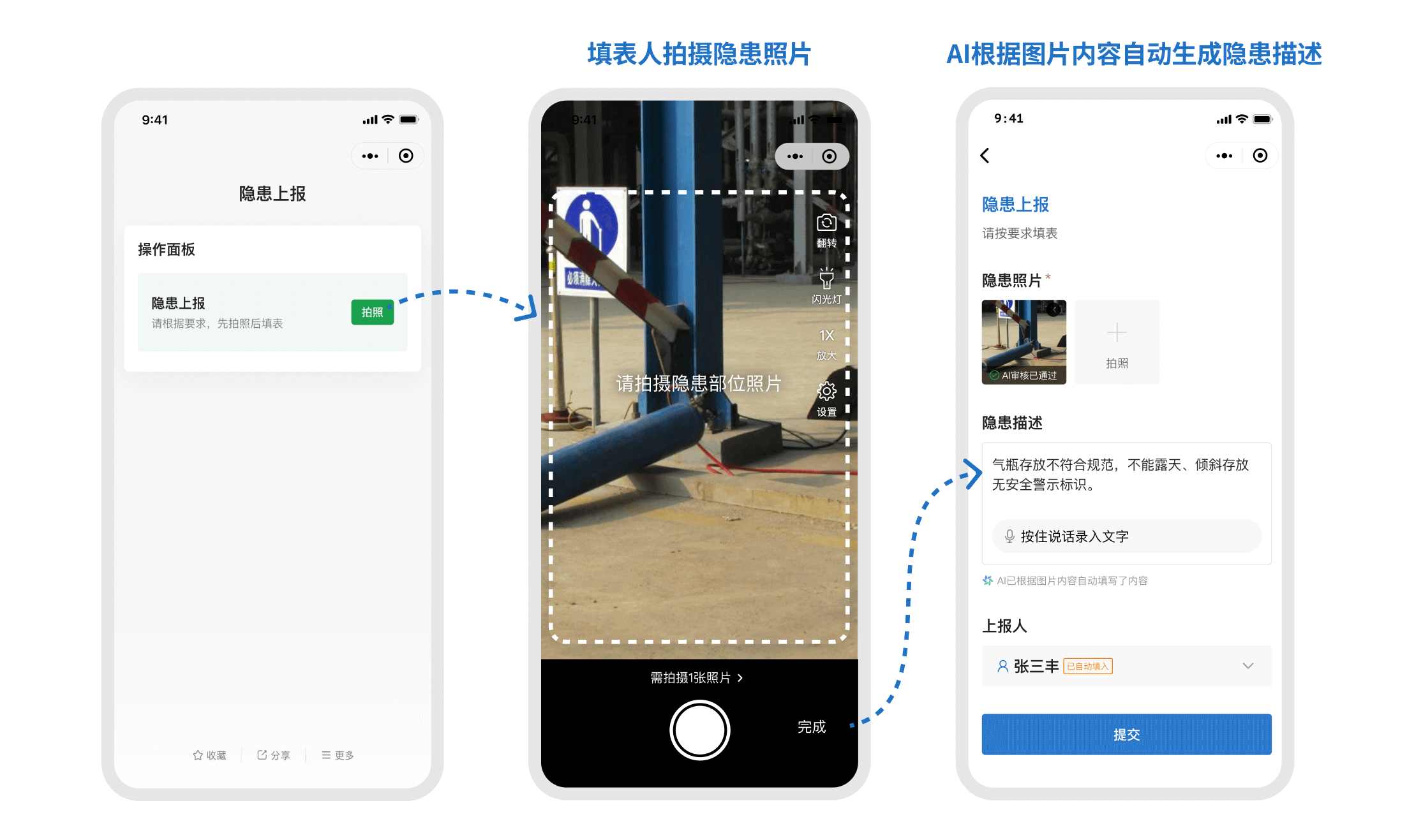
We created dedicated QR codes for each mining area, workshop, and key position, posted on-site. When employees identify a hazard, they simply scan the code with WeChat to access the reporting page. The form includes: hazard type and description, site photos (with location watermark), discovery location, and discoverer. After submission, the information automatically syncs to the backend, marked as "Pending Rectification."

This year, CaoLiao QR codes also introduced an AI Smart Form Filling feature. It can automatically identify the hazard type and location from a photo, and auto-fill the "Hazard Description." The reporter just needs to review and slightly modify the AI-generated content before submitting, making hazard reporting even simpler.
2. System Automatically Notifies Responsible Persons, Tasks Assigned Clearly
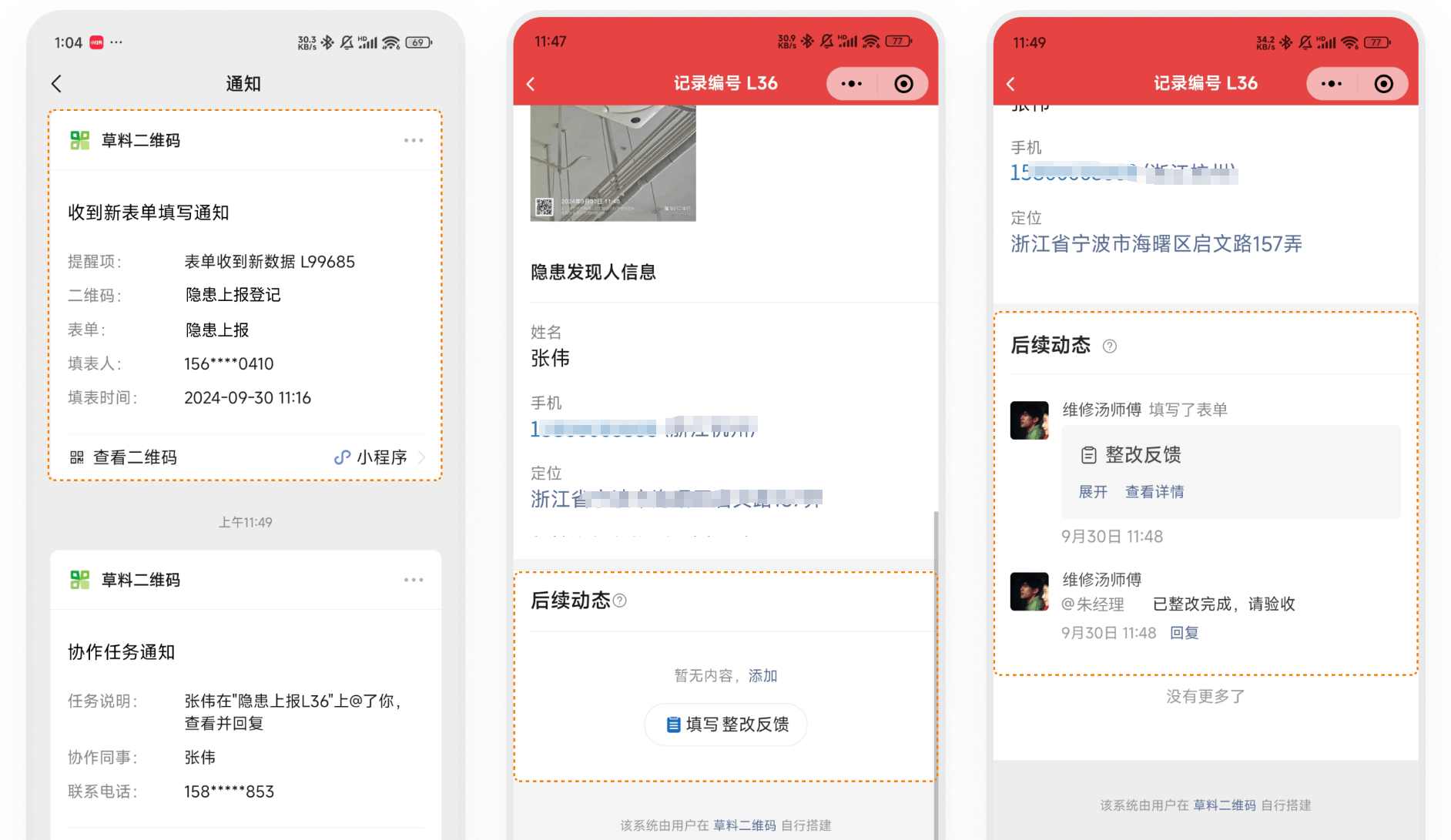
Message push rules can be set in the backend to automatically notify the relevant responsible persons. For example, electrical issues directly @ the electrical team lead. The platform automatically sends WeChat reminders, avoiding delays and forgetfulness associated with manual relay.
We call this step "Information Never Hits the Ground," meaning no hazard gets missed due to forgotten handovers or shift changes. This small step essentially solved our past problem of "reported but ignored."
3. Upload Records During Rectification, Evidence with Photos
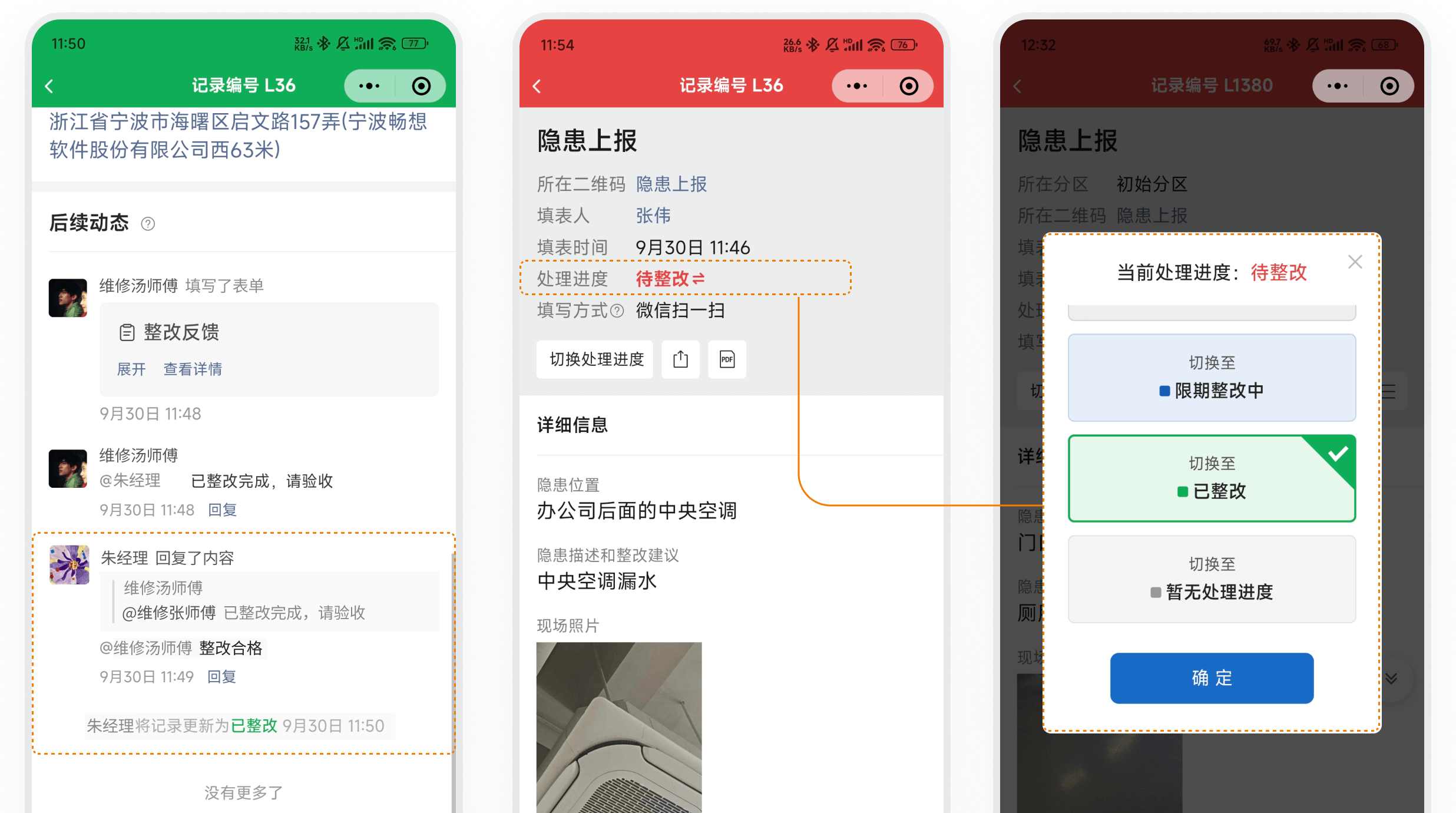
Rectification personnel scan the code to access the hazard details page. They must fill in the handling process, upload photos after rectification (allowing comparison with the reported photos), and update the status to "Rectified." Many initially found this requirement cumbersome, but after a while, they realized it made the rectification process more reliable.
4. Re-inspection and Acceptance via Scan, Ensuring Rectification is Implemented
We also introduced scanning for the re-inspection phase. Safety officers can scan on-site to see how the hazard was reported, how it was handled, view the photos, understand what was done, and then judge if it meets standards. If compliant, the status is marked "Closed"; otherwise, it can be rejected for further rectification. This method doesn't rely on memory and avoids arbitrary acceptance decisions.
5. Backend Allows Instant Ledger Export, Ready for Inspections Without Stress
We summarize hazard data monthly. With one click, we can export to Excel/PDF, automatically archiving the discovery time, rectification process, and acceptance photos for all hazards. This is used not only for internal review but also as material for Work Safety Administration inspections.
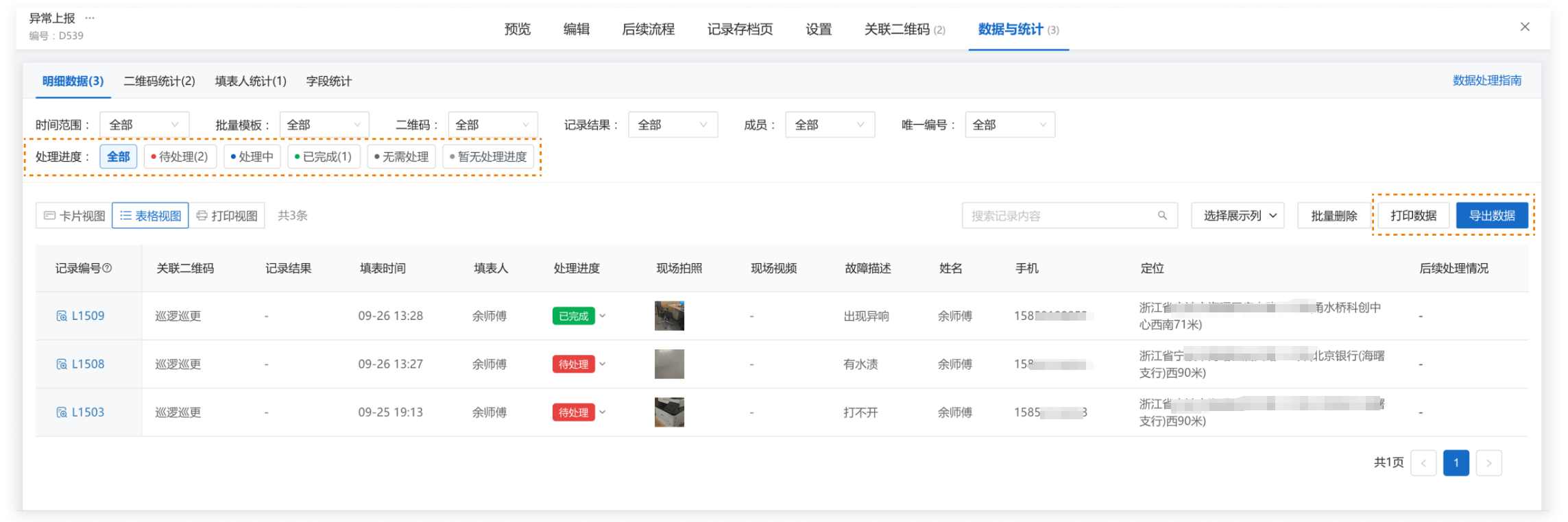
Automatically Generated Management Ledgers, More Confidence During Inspections
Throughout this process, the biggest change we observed is that hazard management is no longer reliant on "shouted orders" but has become a systematic and transparent process. Every hazard, from discovery to rectification to re-inspection, has a record. Management can view data, frontline staff can check progress—all at a glance. At month-end, there's no need to sift through paper files; the CaoLiao backend allows one-click export of the complete hazard ledger.
We previously tried some app-based hazard reporting systems, but employee adoption was low—partly due to perceived complexity, and the need for installation, login, and training. CaoLiao QR codes require none of that; scan and use, bind account via WeChat authorization. The more we used it, the more we felt it was suitable as the "first step in digitalization" for such scenarios.
Not All Systems Need to Be "Heavy"; The Key is Implementability
Now, our monthly closed-loop rate for hazards consistently stays above 95%, and rectification time is nearly halved compared to the past. This wasn't achieved by pressuring staff, but by smoothing the process and establishing the mechanism. Ultimately, many SMEs aren't unwilling to implement closed-loop management; they just struggle to find a method that is both lightweight and easy to implement.
What CaoLiao QR codes provide is precisely such a method. It's not a full-featured EHS system, nor a one-size-fits-all solution. But for mining projects like ours, without dedicated IT staff or development capabilities, having this "scan-to-operate" closed-loop tool has solved our most persistent headache from recent years.
Implementing systems relies on processes, and whether a process can be closed-loop largely depends on the simplicity of the tool. In hazard identification, complexity doesn't necessarily equate to advancement. Implementability, usability, and the ability to leave records are what truly matter.