How Should Small and Medium-Sized Property Management Choose a Visitor Registration Solution? A Guide to Mainstream Practices and Low-Cost Options
Original: https://cli.im/article/detail/2398
In many residential communities, especially older or medium-sized ones, visitor registration is often overlooked as a minor task. However, from the property management perspective, this matter actually involves multiple aspects: security protocols, resident experience, on-site management efficiency, and it may even relate to accountability tracing after emergencies.
Traditional paper-based registration methods have many issues—information is hard to retrieve, easily forged, and lacks proper privacy protection. Nowadays, more and more property management companies are considering digital solutions. But the question arises: with limited budgets and non-specialized teams, what solution is truly suitable?
This article, based on practical usage scenarios, will outline several common visitor registration methods for small and medium-sized property management companies, helping managers find the digital path that fits their needs.
1. Why is a Visitor Registration System Needed?
From a legal standpoint, there is currently no mandatory requirement for all residential communities to implement real-name visitor registration. However, in practice, it is a common consensus for communities to register some information from external visitors. On one hand, it facilitates later inquiries and accountability tracing; on the other hand, it can also serve as a psychological deterrent to strangers to some extent.
Especially in communities with high resident mobility, visitor registration not only serves as an early warning but also reassures residents that someone is genuinely monitoring access control.
The problem is, the traditional method of "handwritten registration + security guard phone notification" is highly inefficient, and paper-based information carries leakage risks. So, how can small and medium-sized property management companies improve their visitor management without a hefty system budget?
2. Comparison of Four Mainstream Registration Methods
1. Handwritten Registration (Traditional Method)
Advantages: No cost investment, intuitive operation. Disadvantages: Low efficiency, inconvenient information retrieval, prone to forgery, privacy exposure.
This method is still used in many older communities. The biggest issue is the lack of effective verification means; visitors can provide fake names and phone numbers without detection, and paper records are easily lost or accessed improperly, leading to information leaks.
2. QR Code Scan Registration
This type of solution is suitable for communities with limited budgets needing quick implementation. The property management generates a visitor registration QR code using a platform (like CaoLiao QR Code), posts it at the gate, and visitors scan the code to fill in information such as name, phone number, and whom they are visiting before submitting.
Advantages:
- No hardware investment required; operates with just a printed QR code.
- User-friendly experience; visitors fill out the form via WeChat scan.
- Data is automatically aggregated, clearly logged, and access controllable.
- Flexible configuration allows adjusting the strictness of registration based on actual needs.
- The free version of CaoLiao QR Code offers sufficient functionality for small and medium-sized properties, with unlimited registrations and submissions.
Considerations: Individuals without smartphones will require assistance from security guards to fill out the form.

3. Property Management App with Built-in Visitor预约 Module
Many property management systems purchased by companies (such as YueJu, Country Garden's Phoenix Cloud, Gemdale's Wisdom Life, etc.) often include a visitor management module. The typical process is: the resident initiates a visitor invitation within the App, generating a time-sensitive visitor QR code. The visitor scans this code for verification before entering.
Advantages:
- Can integrate with access control systems for scan-based entry.
- Residents are预先 informed, enhancing security.
- Data can be stored uniformly and traced.
Disadvantages:
- Requires residents to be accustomed to using the App; otherwise, effectiveness decreases.
- Manual backup might be needed during system upgrades or network failures.
- Significant initial effort required for promotion and resident education.
This method suits communities already using smart property systems with a younger resident demographic. Initial deployment requires coordination with the system developer, but once running smoothly, it can significantly improve overall passage efficiency and resident satisfaction.
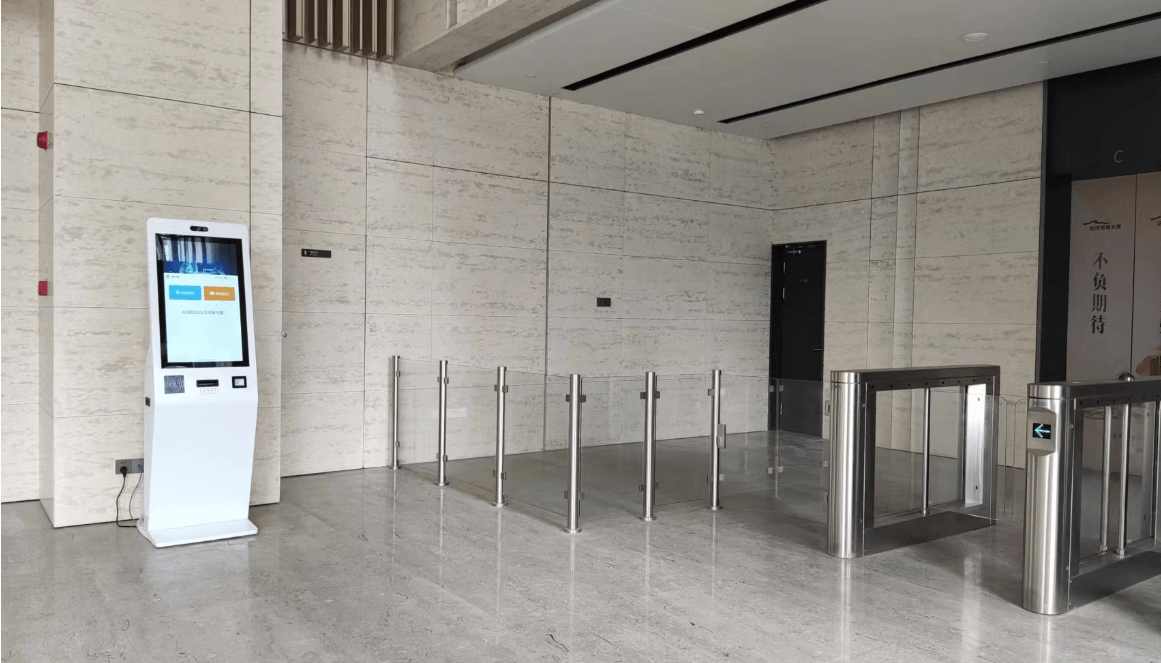
4. Visitor Kiosk / ID Card Recognition System (High-End Solution)
Common in government institutions or upscale communities, these solutions use integrated terminals to read visitor ID cards, perform facial comparison, take photos for records, and some can automatically print temporary passes.
- Advantages: Accurate real-name verification, data can interface with public security systems, enhances the community's tech-savvy image.
- Disadvantages: High hardware costs, complex processes, requires additional compliance measures for handling sensitive information.
For small and medium-sized property management, these solutions often exceed budget constraints. Unless the project has special requirements (e.g., government public rental housing, apartment hotels), they are generally not recommended.
3. How to Choose Based on Different Scenarios?
Faced with these options, small and medium-sized property management can refer to the following suggestions:
| Scenario / Need | Recommended Solution | Reason |
|---|---|---|
| Cost-sensitive, needs quick implementation | QR Code Registration (e.g., CaoLiao QR Code) | Nearly zero cost, flexible configuration, fast deployment. |
| Has property system, residents use App | App Visitor预约 + QR Code Access | High security, standardized process, suitable for mid-to-high-end communities. |
| Extremely high security requirements | Third-party Visitor System + Facial Recognition | High security level, but requires compliant handling of facial data. |
| Unsure which method to use | Primarily QR Code Registration, Paper-based as backup | Practical and stable, allows gradual transition of users to digital methods. |
4. Final Thoughts
There is no one-size-fits-all standard for visitor management. The key is finding a method suitable for the specific community's scale and resident composition. If the budget is limited, starting with a QR code form can save effort while achieving data recording and secure logging.
Tools are merely means; the key lies in consistent execution. Only by truly integrating the registration process into the daily management of the gate can the seemingly minor task of visitor management realize its full value.