Hospital Equipment Management and Health Education: How to Choose Information Tools?
Original: https://cli.im/article/detail/2438
With the acceleration of digital transformation in the healthcare system, more and more hospitals are beginning to re-examine those "inconspicuous but critical" links in their internal operational processes. Medical equipment management and health education are typical representatives: one concerns the hospital's operational efficiency and cost control, and the other carries the mission of improving the health literacy of the entire population. However, according to actual research, the long-standing structural problems in these two areas are far from being effectively resolved.
In this context, the role of tools is being redefined. They are not just "auxiliary execution" but also a fulcrum for streamlining processes, improving experiences, and enhancing quality. This article attempts to provide some actionable references based on frontline practices and the application exploration of CaoLiao QR codes in hospitals.
1. Medical Equipment Management: From Form Records to Refined Digital Management
1.1 High Failure Rates, Alarming Idle Rates: Management Methods Urgently Need Updating
In many hospitals, the procurement process for medical equipment is quite mature, but issues during the usage and maintenance phases have long been overlooked. Frequent failures, high maintenance costs, and low equipment utilization rates actually reflect not the performance of the equipment itself, but the absence of a management mechanism.
The most basic aspect of equipment management—"record-keeping"—still relies on inefficient methods like paper logs, Excel spreadsheets, and offline approvals in many hospitals. Once a failure occurs, information lag, unclear responsibilities, and difficulty in tracing have become common issues.
1.2 QR Code Empowerment: Establishing an "Electronic File" for Equipment and Streamlining Daily Management
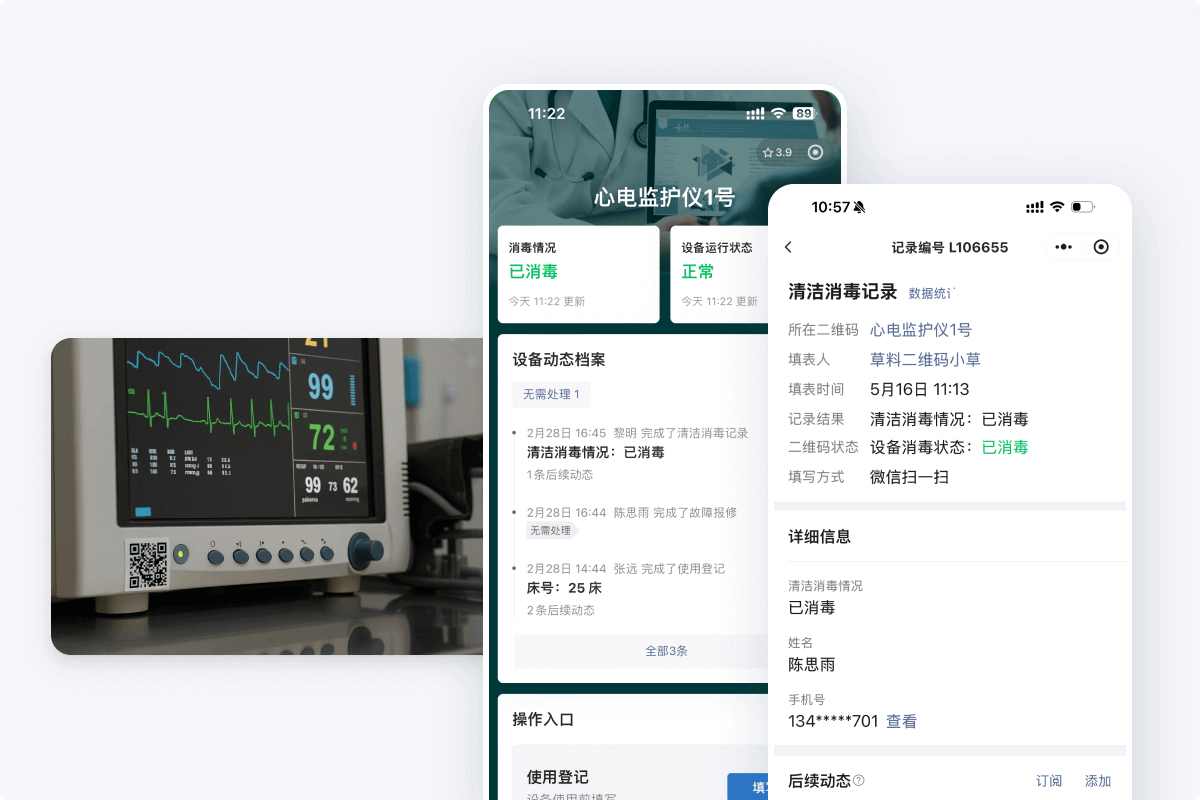
A practical and feasible approach is to create a unique "QR code identity" for each piece of equipment. Using QR code tools like CaoLiao QR codes, which require no local deployment and can be configured online, hospitals can quickly generate electronic file QR codes for each piece of equipment. These QR codes can be posted on the equipment itself, allowing on-site personnel to scan the code and fill out forms for usage registration, disinfection records, repair requests, and more. The backend automatically synchronizes data, making it easy for management personnel to review, statistics, and analyze.
Compared to traditional forms, QR codes offer the following advantages:
- Unified Entry Point: No need for specialized apps; on-site personnel can fill out forms by scanning the QR code with their phones.
- Structured Information: All records are automatically archived under each equipment's name, avoiding disorganization.
- Rich Information Display: In addition to electronic forms, equipment status, photos, and operational guidance documents can also be added to the QR code.
- Effective Repair Closure: If abnormalities occur, scanning the code to report them sends real-time notifications to maintenance personnel, who can promptly follow up based on the fault records and document the entire repair process.
These features lower the implementation threshold for full lifecycle management of equipment and provide foundational data support for subsequent equipment status analysis, budget evaluation, and predictive maintenance.
1.3 Not Replacing Systems, but Filling Gaps
The QR code solution is not intended to replace existing hospital systems (such as HIS, CMMS, etc.) but to address the management gaps for small and medium-sized equipment, portable devices, peripherals, consumables, and departmental-level supplementary inspections that are not yet systematically managed. The advantages of CaoLiao QR codes include:
- Free to Use
- No reliance on local deployment or interface integration;
- Healthcare staff can create content with low barriers;
- Low cost, fast iteration, suitable for rapid pilot testing.
As equipment management increasingly emphasizes refinement and full-process traceability, such tools provide a lightweight, practical digital entry point.
2. Health Education: From "Posters on the Wall" to "Scan the Code for Clarity"
2.1 The Focus Should Be on Effectiveness, Not Just Execution
Health education has long been a representative task that emphasizes "execution over evaluation." Behind quantitative indicators such as how many display boards the hospital produced, how many leaflets were distributed, and how many lectures were held, what is the actual communication effectiveness? Did the patients understand? Did it change their behavior? These are difficult to quantify.
A more common issue is that educational content is often universal and non-personalized, with limited display channels. Once the session is over, there is no follow-up tracking, resulting in low knowledge conversion rates and weak patient engagement.
2.2 QR Codes as Connection Points: Making Educational Content More "Dynamic"
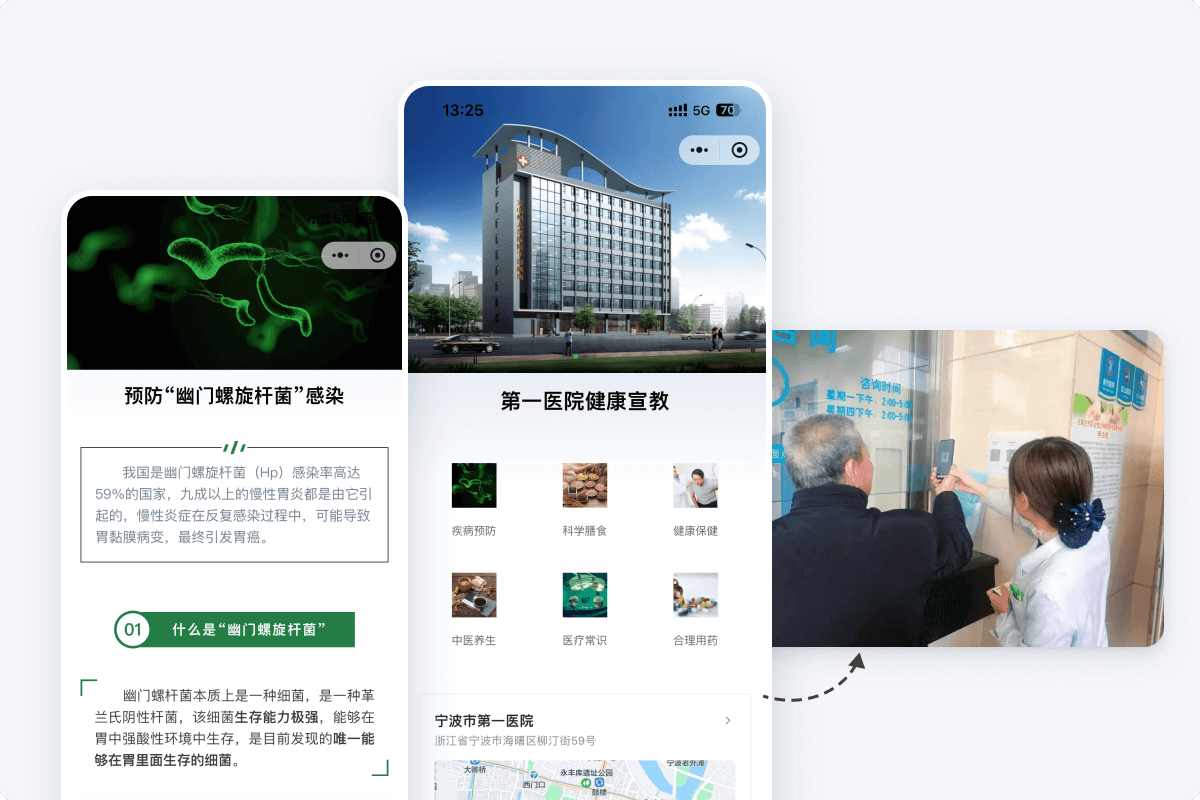
Compared to traditional static displays, QR codes offer the possibility of a "lightweight interactive entry point." By converting educational content into online pages and generating QR codes posted in hospital corridors, waiting areas, and wards, patients can scan the code to access the information. This method has been widely adopted by many hospitals, but further optimizations include:
- Customizable and Updatable Content: CaoLiao QR codes support the generation of "dynamic QR codes," where the QR code remains the same, but the content can be continuously updated. This is suitable for scenarios like disease knowledge and medication usage guidelines that require frequent content changes.
- Categorized Display: The "directory code" feature allows multiple content entries to be aggregated under one QR code, suitable for scenarios like examination instructions, post-operative precautions, and chronic disease education that require multiple explanations to be displayed side by side.
- Embedded AI Interpretation Functionality: After scanning the code, patients can not only view the content but also ask questions directly. The system can provide semantic answers based on the page content, helping patients understand complex terminology and improving knowledge conversion rates.
Through these methods, QR codes are no longer just static links for "scanning" but serve as intelligent entry points for guidance, explanation, and interaction.
2.3 From "What Was Distributed" to "What Was Learned"
Research indicates that the biggest challenge in evaluating health education is the difficulty in knowing whether patients truly understood and remembered the content. Using the AI interpretation feature, common questions asked by patients after scanning the code can be summarized in the backend, helping medical staff judge whether the content design is reasonable, where patients' main confusions lie, and whether the expression methods need improvement.
This approach is closer to reality than mere "awareness rates" and provides data support for subsequent content adjustments.

3. Criteria for Tool Selection: Low Barrier, High Compatibility, and Closed-Loop Capability
From medical equipment management to health education, the common demands of hospitals in tool selection are becoming clear:
- Low Deployment Barrier: No need to integrate with hospital systems or require professional IT support.
- Flexible Content Arrangement: Medical staff can configure and modify content themselves to adapt to multiple scenarios.
- Manageable Data: Filling records can be exported, analyzed, and tracked.
- Closed-Loop Process: Not only "can be filled" but also supports subsequent processing, feedback, and data retention.
Although the QR code solution is lightweight, it performs stably in these dimensions, making it particularly suitable as an intermediate solution for short- to medium-term pilot tests and filling system gaps. For hospitals, before fully deploying large systems or in corners where large systems cannot reach, making good use of QR codes is undoubtedly a pragmatic approach.
Conclusion: Digital Practices from "Usable" to "User-Friendly"
Research shows that whether in equipment management or health education, Chinese hospitals are currently facing immense pressure to transition from extensive management to refined operations. In this transformation, the role of digital tools is not only to replace manual labor but, more critically, to provide an executable, traceable, and improvable mechanism.
CaoLiao QR codes are not a high-barrier, all-in-one complex system. They are more like a portable tool—before hospitals achieve comprehensive digitalization, they can establish a standard, unified, and clear entry point for a specific link, allowing data to accumulate, processes to standardize, and minor issues to no longer be overlooked.
This may be the most needed and realistic professionalism at the current stage. We cannot expect tools to solve all problems, but at least we can use them to drive change.