Inadequate Inspections, High Equipment Failure Rates? How to Build a Closed-Loop Inspection Mechanism
Original: https://cli.im/article/detail/2410
"We scheduled inspections, but the equipment still fails frequently." "Inspection forms are filled out daily, but when a problem occurs, no records can be found." "Problems were found, photos were uploaded, but no one handled them. Accountability only happens after equipment shutdowns." These scenarios are common in many manufacturing companies, property management units, and energy facilities. Equipment inspection is a crucial part of ensuring stable production and preventing risks. However, in practice, many companies' inspection mechanisms remain at the "formal completion" stage and struggle to achieve a true closed-loop process.
1. Why Are Inspections "Done" but Ineffective?
Many companies have inspection systems and forms, and some have even implemented apps or software systems. Yet, equipment failure rates remain high. The core issues often lie in the following areas:
- Inspections Not Actually Performed Employees go through the motions of clocking in or copying meter readings without truly looking at the equipment, naturally failing to identify problems.
- Records Lack Traceability Paper records are filed away after completion, lacking structured information like time, personnel, and specific content, making subsequent verification impossible.
- Ineffective Exception Reporting Mechanism Discovered issues are only reported verbally or in group chats, with no one taking ownership, recording, or following up.
- Lack of Resolution Records Whether issues were resolved, by whom, and how relies solely on verbal feedback, making supervision and review difficult.
- Lack of Data Accumulation and Analysis Fragmented records prevent systematic understanding of which equipment or time periods have concentrated issues. Inadequate inspections lead to late problem discovery and slow response, ultimately causing frequent equipment failures, disrupted production schedules, and increased maintenance costs.
2. Key Elements of a Closed-Loop Inspection Mechanism
A truly closed-loop inspection mechanism doesn't necessarily rely on large-scale systems but should at least include the following elements:
- Clear Plan Inspection content is clear, cycles are reasonably set, and responsible persons are identified.
- On-Site Execution Designated personnel complete the forms on-site as required, without falsification.
- Exception Recording Problems are recorded promptly with accompanying photos for easier assessment and handling.
- Follow-Up Actions Problem resolution details can be updated within the original record, completing the handling loop.
- Accessible and Usable Data All records are stored structurally, allowing for export, statistics, and archiving, facilitating management and analysis.
In other words, the core of a closed-loop mechanism is whether the chain of problem discovery → recording → follow-up → resolution completion can be executed smoothly, leaving traceable evidence.
3. How to Use CaoLiao QR Codes to Build a Lightweight, Closed-Loop Inspection Mechanism?
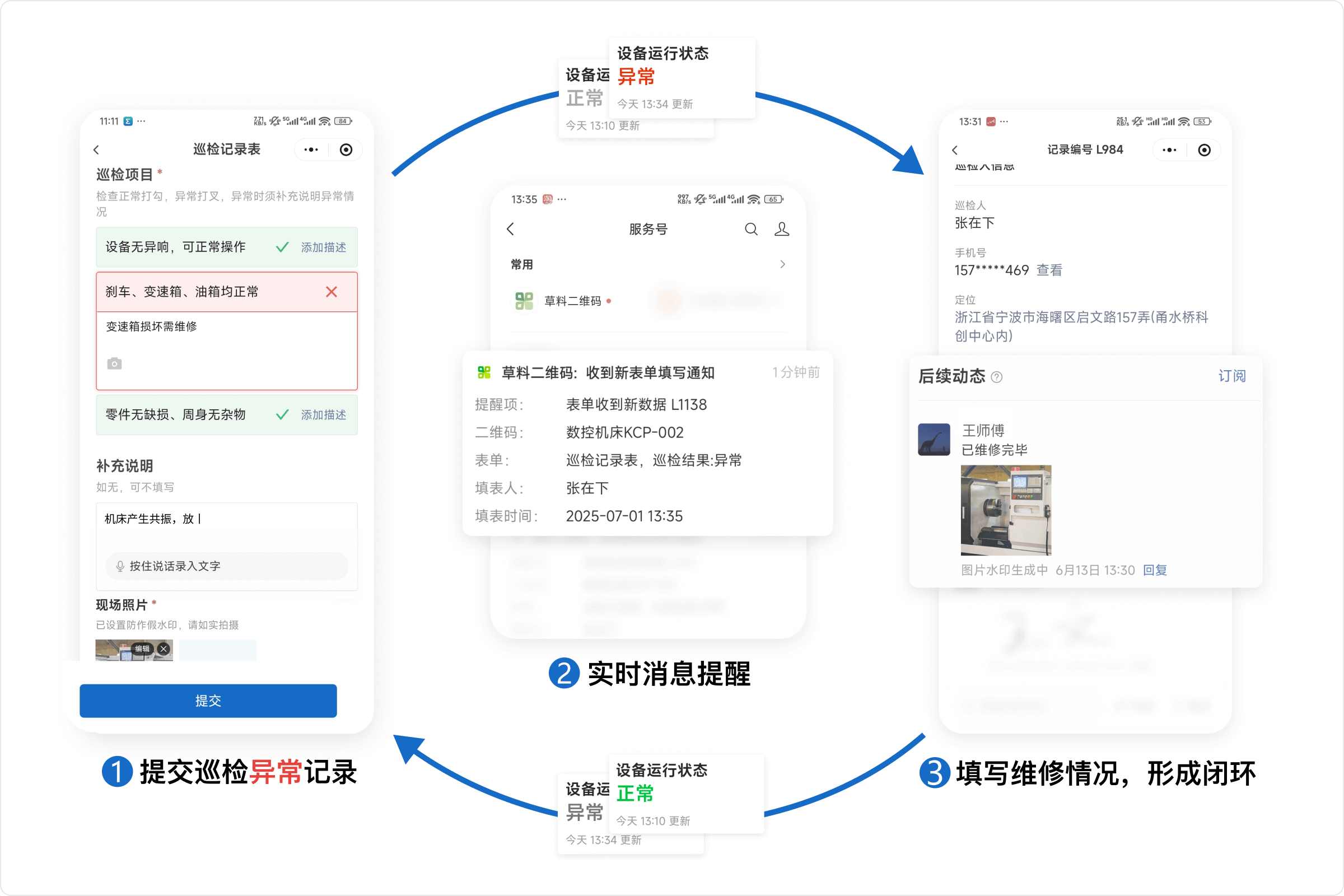
For small and medium-sized enterprises, deploying a full MES or equipment management system is often too costly and has a high operational barrier. CaoLiao QR Codes offer a relatively lightweight approach that can cover multiple key nodes of inspection work, forming a "simplified yet closed-loop" management path. Below is an illustration of a closed-loop inspection mechanism designed based on CaoLiao QR Code features:
Generate a Unique QR Code for Each Equipment Item for Scanning to Fill Inspection Records Each piece of equipment is labeled with a unique QR code linked to an electronic form. Tasks are automatically scheduled. Inspectors scan the code on-site to fill out the form, including check items, parameter values, site photos, and exception descriptions. Normal items are simply checked off; problematic ones require detailed notes, saving time while ensuring quality. CaoLiao's forms support various field types and can be customized by equipment type, ensuring targeted content. Features like location restrictions for scanning and photo watermarks help prevent falsification.

Instant Notifications for Exceptions, Forming a Handling Loop If an exception is found, the result is pushed in real-time to the maintenance supervisor, who can open it to see fault details without waiting for phone reports, enabling faster repair responses. Maintenance personnel directly record repair details under the original inspection record, linking the data, clarifying responsibility, and facilitating traceability.
Centralized Summary of All Inspection Records for Easy Querying and Analysis All inspection records are automatically aggregated into the data table within the CaoLiao workbench. They can be exported to Excel by cycle/department, making statistical analysis and archiving effortless. This feature helps managers identify recurring problem equipment and links, and facilitates assessment of resolution rates and response times.

4. Final Thoughts
Inspection is a task that is "done daily yet easily overlooked." It connects on-site management, equipment safety, and operational efficiency. An effective inspection mechanism isn't about using the most complex system, but about whether the information flow can be recorded, discovered, processed, and verified.
The combination offered by CaoLiao QR Codes—"scan to record + handling loop + centralized data export"—provides SMEs with a low-cost, highly flexible, and implementable closed-loop inspection solution. If your company also struggles with inspection management, why not start with a batch of equipment, one QR code, and a simple form for a trial? You can establish a closed-loop path without waiting for a full-scale system rollout.
A true closed loop isn't about the system automatically dispatching work orders; it's about the entire chain of responsibility that managers can "see, follow up on, and investigate clearly."