QR Code Vehicle Management Solution: Scan to Register, Automatic Vehicle Status Updates
Original: https://cli.im/article/detail/2429
In many organizations, campuses, or project sites, daily vehicle management often relies on paper logbooks, WeChat group notifications, or verbal requests. These methods may seem "simple," but when problems arise, they often prove inadequate: registration information is hard to find, vehicle whereabouts are unclear, and responsibility is difficult to assign.
Is there a way to standardize the borrowing and returning process without adding significant management burden?
A QR code is all you need.
Borrowing and Returning Registration: Scan, Fill, Trackable Records
Generate a unique QR code for each vehicle and affix it inside the vehicle or at its storage location. Users simply scan the code and fill out a form before and after each use to complete the borrowing registration and returning confirmation. The form can include fields such as user name, department, contact information, purpose, estimated return time, etc., and supports custom fields to adapt to different organizational management requirements.
Compared to traditional paper-based registration, this approach offers several distinct advantages:
- Real-time Online Access: Scan and fill out the form anytime, anywhere, without relying on a fixed location.
- Automatic Archiving: Every record is automatically saved and can be viewed or exported from the backend at any time.
- Prevent Omissions: Supports required field settings to avoid missing or胡乱填写 information.
More importantly, it doesn't require developing a separate system or relying on specialized hardware. Managers can quickly set this up using tools like CaoLiao QR Code. 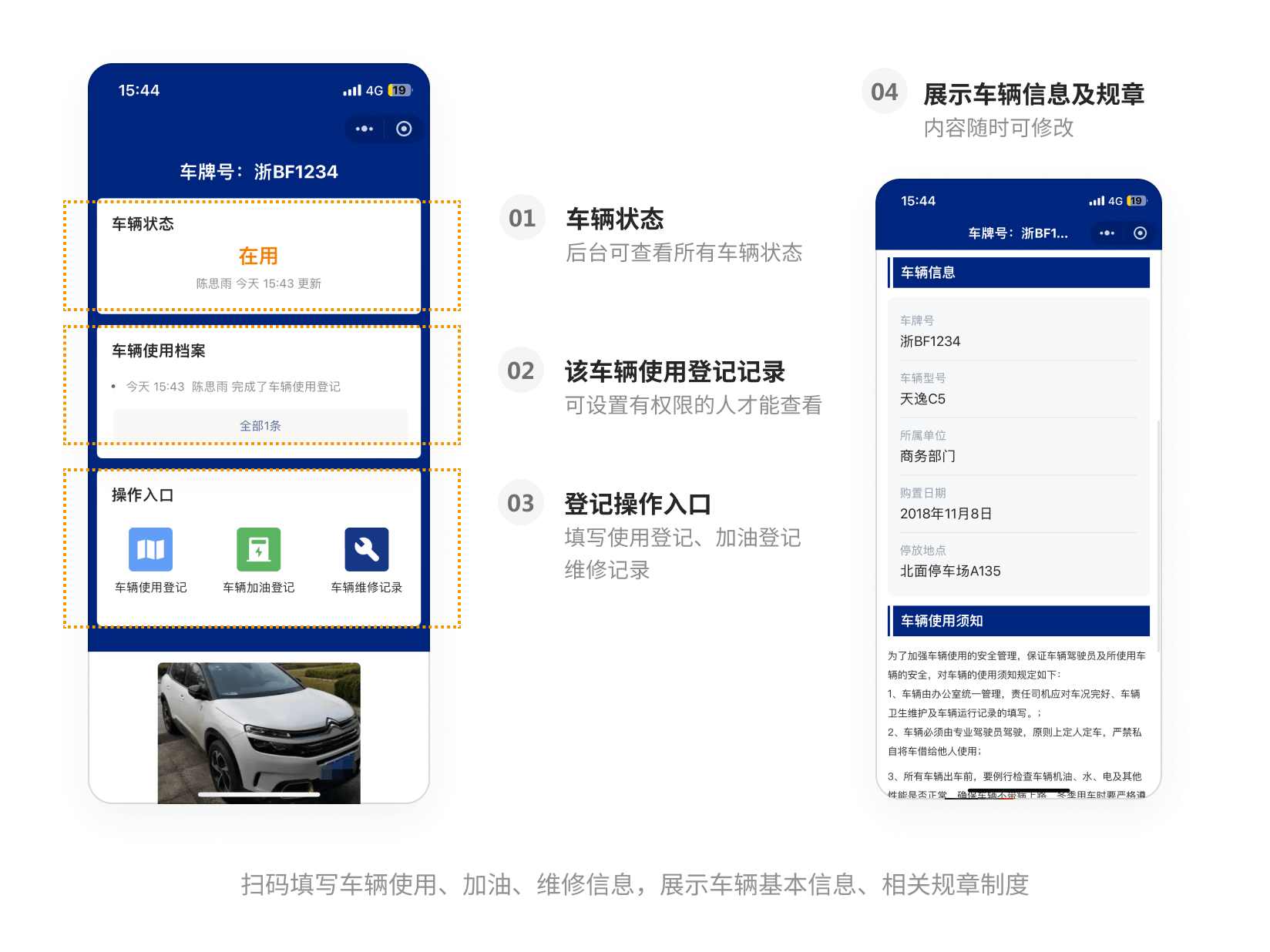
Automatic Vehicle Status Updates: No Manual Maintenance Required
Beyond registration records, real-time updates of vehicle status are also a key management focus. For instance, knowing which vehicle is borrowed, who is using it, and when it's expected to be returned often relies on managers manually updating whiteboards, synchronizing via WeChat groups, or making phone calls.
By linking the borrowing/returning form with status synchronization settings, the system can automatically update the vehicle's status—for example, from "Available" to "Borrowed"—upon checkout or return, and display it clearly on the vehicle's information page. This method effectively reduces information delays and errors, allowing managers and colleagues to keep track of vehicle usage at any time.
Managers can view borrowing and returning records on their mobile devices or computers and export all records whenever needed, eliminating concerns about data preservation.
Summary Directory: Centralized Overview and Management
If an organization manages multiple vehicles, relying on individual QR codes alone makes it difficult to get an overall picture. This is where the "Directory Summary" feature becomes useful.
Administrators can consolidate all vehicle QR codes into a single directory page, displaying basic information and the current status of each vehicle. Keyword search functionality allows users to quickly find the QR code page for their target vehicle.
This centralized display method facilitates user searches on one hand and enhances management transparency and control on the other—it's immediately clear which vehicles are in use and which are currently available. 
Lightweight Management Process, Suitable for Most Scenarios
Setting up vehicle borrowing and returning QR codes is not complicated: find the vehicle usage registration template in the CaoLiao QR Code platform's template library, generate and print them in bulk, and they can be deployed within a day. Subsequent maintenance is also very convenient—content changes can be adjusted online at any time, and information viewing can be filtered and exported based on conditions, requiring no development or operational resources.
This solution is suitable for various types of organizations, such as:
- Administrative fleets in enterprises and institutions;
- Construction vehicles on project sites;
- Commuter vehicles or shared electric scooters on campuses and in schools;
- Rental vehicles in tourist attractions...
Whenever the scenario involves "multiple users sharing and multiple borrowings/returns," consider using QR codes to standardize processes and improve efficiency.
Final Thoughts
Vehicle usage management might seem like a minor detail, but it's an indispensable part of daily operations for many organizations. Instead of assigning blame after problems occur, it's better to streamline processes and tools with a replicable, practical solution that digitizes and structures registration, status, and information display.
QR codes are not a universal tool, but in the relatively standardized and clear-process scenario of vehicle management, they are sufficiently effective, lightweight, and worth trying. You only need to set it up once, and then let the process run itself.